11 min read
Easy Guide: How to Use FAQ™ 502 Full-Spectrum Red Light Therapy

So, you've treated yourself (or got treated) to a brand new FAQ™ 502 full-spectrum red light therapy. Congratulations, good for you, and welcome to an at-home revolution in non-invasive anti-aging. If you're consistent, people will start squinting at you, trying to figure out if your "sick leave" last week was code for getting a bit of work done. But those of us who've read up on red light therapy and especially full-spectrum red light impact on various skin layers know that we need no blades cutting into our flesh to look refreshed and younger. Light can do a lot of the work, because light is energy.
All life, the thriving and the dysfunction of it, is all a matter of energy availability and utilization. Getting more energy to sluggish cells, which inevitably slow down in renewing themselves as we age, is the difference between looking younger and looking run down and prematurely aged. We say prematurely because you’ll age regardless. You can’t choose to stop aging, but you can choose how you’ll age.
We also know that looking younger is about getting more oxygen and nutrients to cells stuck in survival mode, so they can burn more food in the presence of abundant oxygen to produce more cellular energy in their mitochondria. This means that instead of merely surviving, cells have enough energy to fix, repair, and revive processes crucial for skin healing.
Read up more on the mechanisms of increased energy production and other red light therapy benefits here: Does Red Light Therapy Really Work?
Healthy skin as a whole is the sum of individual healthy skin cells working at optimum levels. I'll leave links to hard science made common sense about what happens inside the skin when exposed to red light therapy. For more details on light as energy, device features and benefits, and a comparison between the basic and advanced models from the FAQ™ 500 collection, see: FAQ™ 501 vs FAQ™ 502: Which One is Right for You?
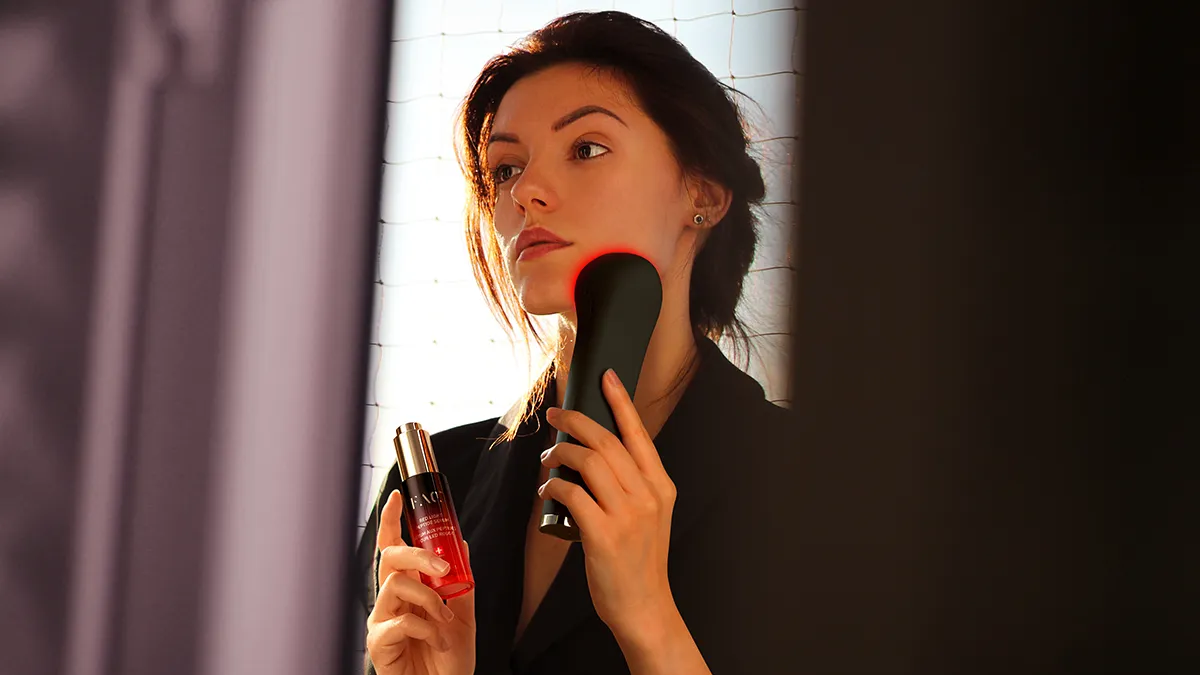
Here, I'll just quickly run through a basic refresher that should be enough to help you understand how this full-spectrum red LED face wand works. I'll also explain the difference between traditional red light therapy, full-spectrum light therapy, and sunlight, and explain why full-spectrum has a much more profound effect on skin health than just a single wavelength of red light. We'll do a brief overview of the device's features and benefits, but feel free to skip that part if you've read the documentation on your device, or already went deeper on the topic in the FAQ™ 501 vs FAQ™ 502 comparison above.
My goal today is to make tech easy and accessible, democratize high-end technology, and help you understand how to use FAQ™ 502 in the simplest, most effective way to get professional results. Life is already complicated enough. Skincare doesn't have to be. Grab a snack, and let's go, dear!
Sunshine vs. red light vs. full-spectrum red light
Sunshine giveth and sunshine taketh away. The dual-faced healer and destroyer, sunlight isn't just the ordinary light you use to see and not trip over stuff. It is energy, a composite of various wavelengths, including X-rays and radio waves, invisible infrared and ultraviolet rays, and a small sliver of visible light nestled in there.
This light composite made possible and raised all life on this planet. It contains the beneficial wavelengths that help our bodies heal and restore. They set our circadian rhythms, grow our food, help hormone synthesis, and protect our sanity, but let UV scorch you for long enough, and you'll get burns as well as damaged and mutated DNA, leading to the development of cancer.
This is a very real fear and an important question newcomers to red light therapy ask: Can red light therapy cause melanoma? No. Unlike UV rays, red and near-infrared (NIR) light are non-ionizing, meaning they do not have the power to knock electrons out of their path, damage DNA, or mutate skin cells, and therefore cannot initiate carcinogenesis.
What red and NIR light therapy can do is positively affect living cells that have started to slow down by:
- Stimulating cellular energy (ATP) production
- Supporting tissue repair and regeneration
- Boosting collagen synthesis and skin health
Red light is a part of the visible spectrum; NIR still offers some visible glow depending on how close it gets to infrared (IR), but IR is fully invisible to our eyes, although some bugs and reptiles can see it.
NIR penetrates deeper into tissues than red light therapy, and IR penetrates deeper than NIR and is mostly used for deeper tissues, like, for example, muscle recovery and alleviating joint pain and inflammation in general. IR is the part of the spectrum that warms you through your shirt on a sunny day, even though you cannot see it. It penetrates the clothing like it’s nothing.
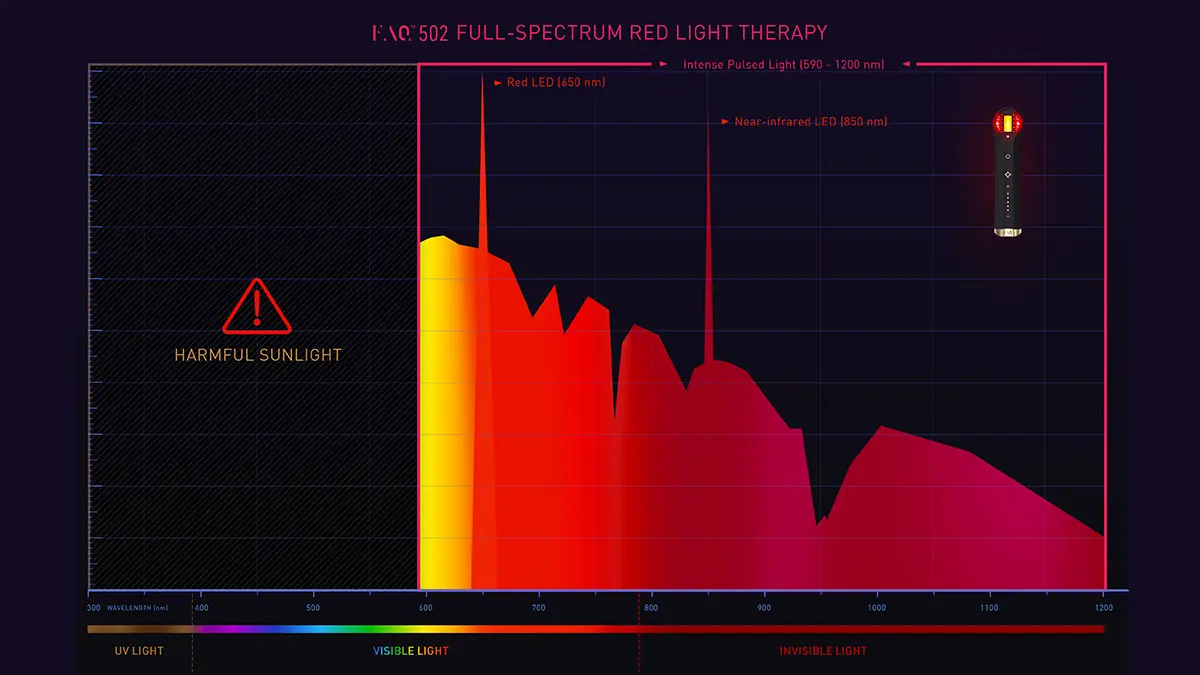
So, why do you even need a FAQ™ 502 full-spectrum red light therapy device when you can just get out in the sun? Because out in the sun, the cons soon outweigh the pros. After about 15 minutes of direct sunlight with no sun protection, UV radiation and blue light start to cause photoaging. DNA strand damage and hyperpigmentation. Sun damage accounts for about 90% of premature skin aging. That's why FAQ™ 502 is superior and can reverse a lot of the existing damage - because it delivers the healing wavelengths, minus the harmful ones.
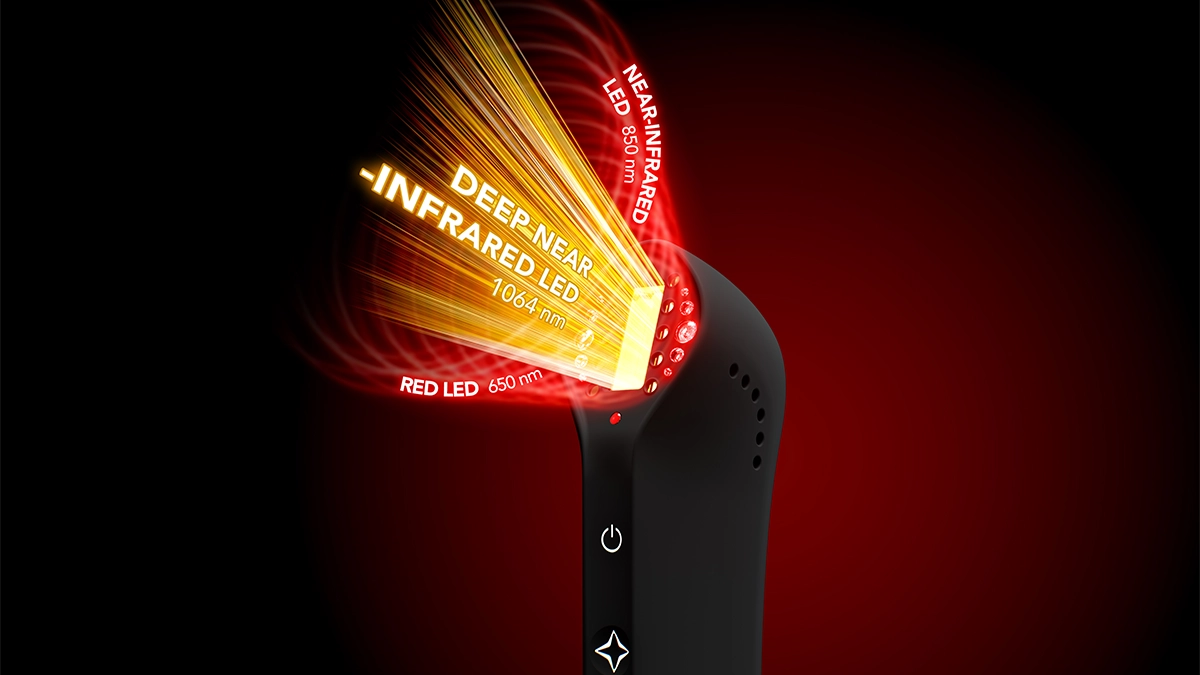
FAQ™ 502 device full-spectrum red light therapy consists of
Narrow LED wavelengths
- 650 nm red, which targets superficial layers
- NIR 850 nm, which penetrates deeper into the dermis
with
Broad-spectrum pulsed light
- 590-1200 nm that goes into mid to deep dermal layers, to fix the failing scaffolding to the top layer of skin
This is why FAQ™ 502 is different; this is what full spectrum means - having all of these wavelengths together, cooperating and becoming more than the sum of their parts.
Red light therapy we're used to experiencing before this fusion mostly offered a single clinically proven wavelength of red light (like 650nm alone) and hit a specific skin layer. It worked, but had its limits. Imagine the difference between a drop of water and a wave. A drop alone can be powerful and drill through stone given enough time, but a wave of many drops at once can break a wall far sooner. Both have their place and are valid; the 502 is a wave rather than a drop, and it does more in less time.
FAQ™ 502 Benefits
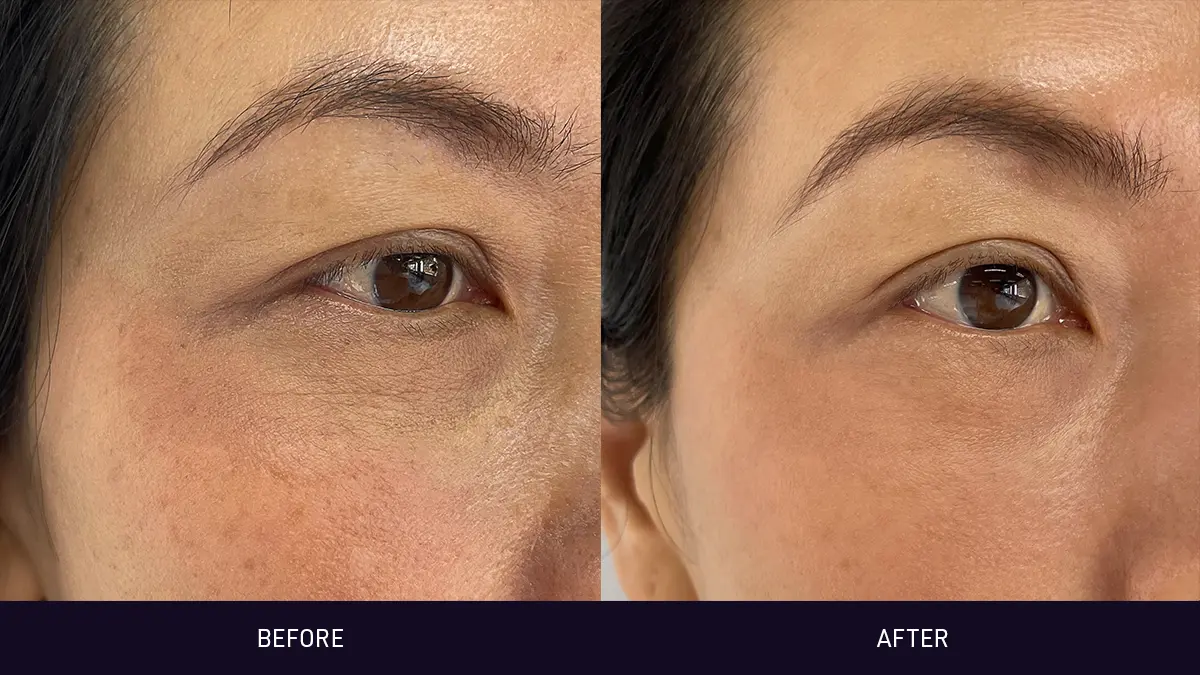
Consistency with a full-spectrum red light therapy device will pay off, but it takes patience. You're literally rebuilding stuff from the cellular structure up. You're turning back time, but you're on a cellular clock for restoration. It is not covering up a problem with witha topical or a temporary instant fix like an application or some mechanical force like face tape, nor is it a radical rearrangement of your facial features that cosmetic surgery can give. It'll take weeks to see first results, and then you'll start noticing more and more cumulative improvement.
The main benefits of FAQ™ 502 wavelength interactions fall into these few categories:
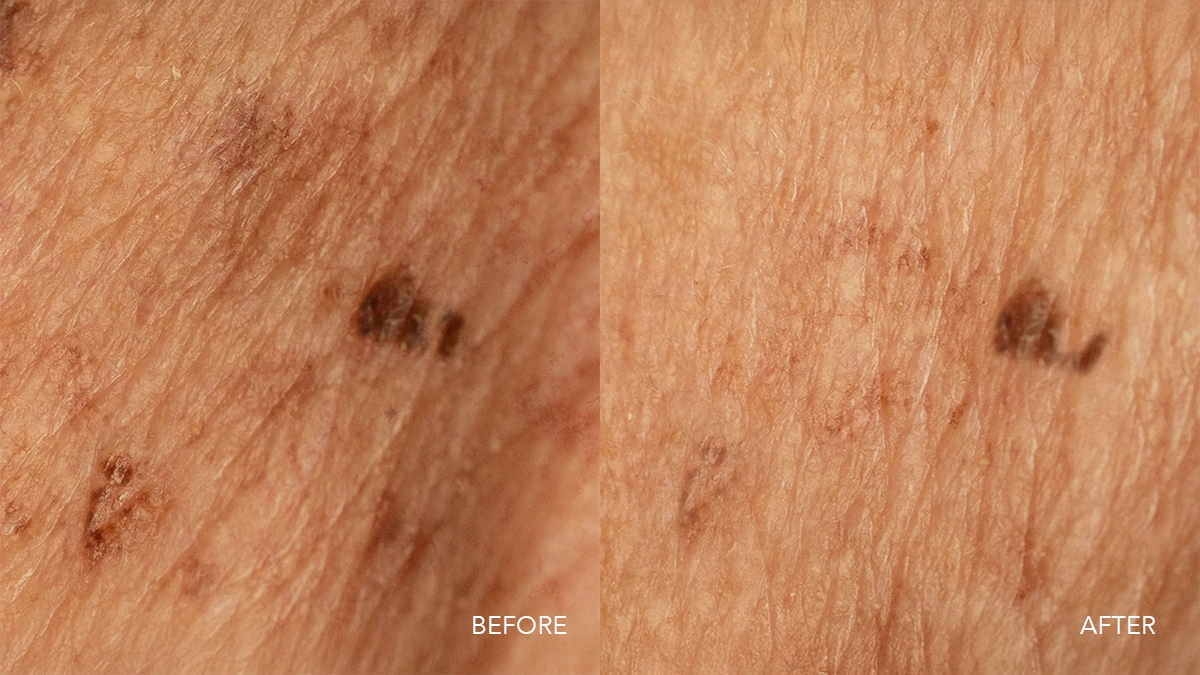
I urge you to read up more on clinical evidence and user-reported results of FAQ™ 502 at the link here: Clinicals Proof & User Reviews of FAQ™ 500 Collection - Is it Worth it?
Spoiler alert. It is worth it, but you shouldn't trust a random middle-aged lady (who refuses to look it) on the Internet. Go review the data, collected based on 3rd-party clinical testing with 30 healthy female & male subjects aged 32 - 55, over a 28-day period.
Now back to our core question: How to use FAQ™ 502?
Step-by-step tutorial: How to use FAQ™ 502?
We've all been there. Getting a new piece of tech, skin tech, or any other, unpacking and feeling excitement mixed with the daunting question of how are you ever going to get the hang of all these features? You will, after a period of searching for the best fit, find a program that suits your needs and preferences best and end up using mostly that one, just like with all other tech you use. The dishwasher may have 16 cycle options and can launch a rocket into space, but you always end up using program three because it gets things clean and finishes faster.
I want you to get the hang of some very easy controls on FAQ™ 502. My goal is for you to come out of this having learned how to use FAQ™ 502 to get the best possible results and confidently switching left and right until you find your favorite. If you have the device on hand, keep it nearby and follow along, especially if you remember things better with visual aids.
Before first use (you'll need to do this only once)
Before first use of your FAQ™ 502 full-spectrum red light therapy device, download the FAQ™ Swiss app (for Android or iOS) to unlock and register your device, and activate the warranty.
All FOREO Sweden and FAQ Swiss devices come locked for your protection, so you can be sure you got a brand new, never used, original device, rather than a lookalike, and the warranty protects you from faulty craftsmanship. This step is also for the Swiss brand's own protection, to safeguard its reputation from the flood of subpar copycats.
Now to the use of the device.
1. PREP
There is no special prep. Just like with all other skin treatments, your first step should be freshly cleaned and dry skin. This is a non-negotiable. If you don't clean your face well, especially after wearing heavy makeup or sunscreen all day, nothing will work, and all of your treatments will be wasted money. So get your skin nicely clean and dry. Use a double-cleansing method if you're feeling especially grimey today.
Once clean, grab some protective sunglasses because there will be some intense flashing lights. This applies to all red therapy devices - wear protective eyewear if the manufacturer of your device suggests it.
Find out more on the dangers of red light therapy for the eyes here: No Eyeballing, Just Facts: Is Red LED Therapy Bad for the Eyes?
TIP: Combine red light with a topical
If you wish to hit your problem - be it fine lines and wrinkles, dullness, or inflammation - from the inside and outside, you can combine the full-spectrum red light therapy with a performance-enhancing topical.
FAQ™ Red Light Peptide Serum was designed specifically to speed up results of FAQ™ red light therapy devices. Plus, peptides are basically building blocks of life (not a figure of speech), so you’ve got that going for you. Other hall of fame ingredients include Sea Daffodil for a radiance boost and fading hyperpigmentation, Hyaluronic Acid (HA) for deep hydration, calming and protective Green Tea, and Cica that helps in the recovery and healing of even the most sensitive skin.
2. SELECT INTENSITY
This is easy peasy. Just press the universal button to turn on your FAQ™ 502 device. Then you can freely adjust the intensity by pressing the + and - buttons. That's it. Some like it very intense; some like to start mild and build up to the stronger settings. You do you, boo.
If you're unsure of how to proceed, you can always learn some facial movements and settings from the video-guided treatments in the FAQ™ Swiss app, where you can also find more settings for radical customization of every technology.
3. REJUVENATE
Lightly place the silicone shield on your skin. The silicone shield partially protects your eyes and prevents light from dissipating around the area, focusing irradiation on the treated area.
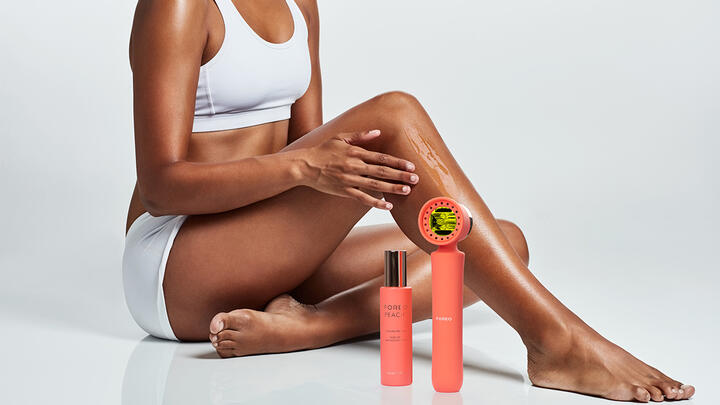
You can also make your life easier and just press and hold the flash button for larger areas as you glide, or press and release to control the individual flashes on small or more sensitive areas, where you should also lower the intensity if you’ve been working on level 4 or 5. For example, the under-eye area has far thinner skin than the forehead or cheeks, and levels of 1-3 will be plenty. Treat for up to 2 minutes, 2-3 times per week.
This is pretty much all you need to know about the device controls. A lot of time was invested in making this device interface very user-friendly and elegant.
Important bonus info
Besides the naked facts on how to use FAQ™ 502 instructions, there are also a few other things to keep in mind since this is a potent device, so remember:
- Put on protective eyewear before your treatment. This is worth mentioning once more.
- The silicone shield must be in full contact with the skin for the pulsed light to work properly, but the treatment window should not be touching the skin, so DON'T press too hard. Glide.
- FAQ™ 500 devices are meant to be used with upward and outward motions. Whenever possible, move from the center of your face toward the hairline.
- FAQ™ 502 has 5 intensity levels. Use intensity levels 1 - 3 for sensitive areas of the face and neck, especially if you're just beginning.
- If you've got tattoos, open wounds, or dark, raised, or irregular moles, don't use the device on these areas. Red light therapy is safe for a large majority of people, but there are some groups that are better off refraining from it.
Read more on who should be careful with red light therapy, and if you're not sure if you fall into any of these categories, best to talk to your doctor.
Who Should Not Use Red Light Therapy? Risks & Safety 101
Basic red light aftercare tips
Red light therapy sends potent energy into cells, and there is a reason we do treatment for a specific period of time. More is not necessarily better because biological systems respond biphasically to various stimulants. Understanding that your cells are doing major overhauls after red light therapy is crucial to know how to back off, get out of your own way, and give your biology the time and space to repair and fix damage.
- These are a few useful tips that can help you in 502 aftercare to get the best results long-term:
- Apply a gentle, hydrating moisturizer after each treatment. Well-hydrated skin repairs itself better. If you used the FAQ™ Red Light Peptide Serum for the treatment, it already includes these hydrating elements, and you don’t need to do anything else.
- Avoid harsh exfoliants, aggressive retinoids, or direct sun exposure for at least 48 hours post-treatment. Skin cells have a lot to do after the energy influx and need to prioritize recovery and revitalization, rather than fixing current damage.
- Use broad-spectrum SPF 30+ daily, as your skin will be more sensitive to UV exposure, but this is good advice even without red light therapy. Sun damage will get people in the end, no matter how well they take care of themselves.
- Recommended usage: The device is really strong, so use it 2-3 times a week. Three times if you're using it on the low settings.
There you go. I hope you found this helpful and your device ridiculously easy to use - turn on, adjust, and glide. I hope you stay consistent, see the first benefits in a few weeks, and achieve your goals while enjoying your gorgeous skin. Stay cool, curious, lovely, and remember that growing old is a privilege not everyone gets.
If you’re interested in other types of light therapy, feel free to explore the entire range of FAQ™ light therapy devices here: How To Choose an FAQ™ Swiss Collection Device?




Leave a comment