26 min read
Red Light Panel vs Mask: Effectiveness, Advantages & Limitations

I’m not old enough (yes, I‘m sticking to this story) to be called cynical, so my utter disbelief at random claims is viewed as charmingly stubborn or saucily skeptical. Red light therapy is no different. When it came to the red light panel vs. mask question popping up all around lately, it pinged on the old heartstrings, making the familiar sound of squinted eyes and an unconvinced “Hm!?”
What about these red light devices is so interesting to people? Do you need one, the other, both, or… either? Is it like red light Pokémon, just a new fad of overconsumption where you need to collect them all, or do red light masks and panels have visible (and felt) effects on signs of aging, circadian rhythm, muscle recovery, joint health, and holistic wellbeing? Spoiler alert: Yes, they do work (all the way down to the cellular organelle level) and have a really strong biological foundation.
I’ve also noticed that there’s a particular kind of optimism that happens when someone buys their first red light therapy device, a gentle auto-lulling themselves into an idea that the sole act of purchase will biohack their skin and bodily systems (unfortunately, no, consistency is key; nothing works if you don’t use it or use it right). That’s why I’ve taken my good ol’ magnifying glass, rolled up these sleeves, and decided to go elbow-deep into this red light panel vs. mask thing, so you don’t have to waste your money on subpar stuff. Do they work at all? On what does the efficacy of red light therapy hinge, and which one actually works better? The quality of products you choose to buy is like voting with your money; you set the boundary of what is acceptable and what is not.
The answer to this riddle is far less dramatic than the Internets would like you to believe, with claims usually along these lines:
- wildly exaggerated claims about collagen synthesis and “fat melting,” or
- aggressively oversimplified advice that ignores how light therapy actually works in the biochemical environment of a body.
So let’s do this properly. Because red light therapy isn’t magic, but it is biologically interesting, it manipulates the fundamental life processes of cellular energy production. The differences between a mask and a panel aren’t just aesthetic and monetary; they also affect dosage, coverage, comfort, consistency, and possibly results, depending on your goals (wrinkles? acne? recovery? sleep issues? hyperpigmentation? chronic tension? full-body benefits?).
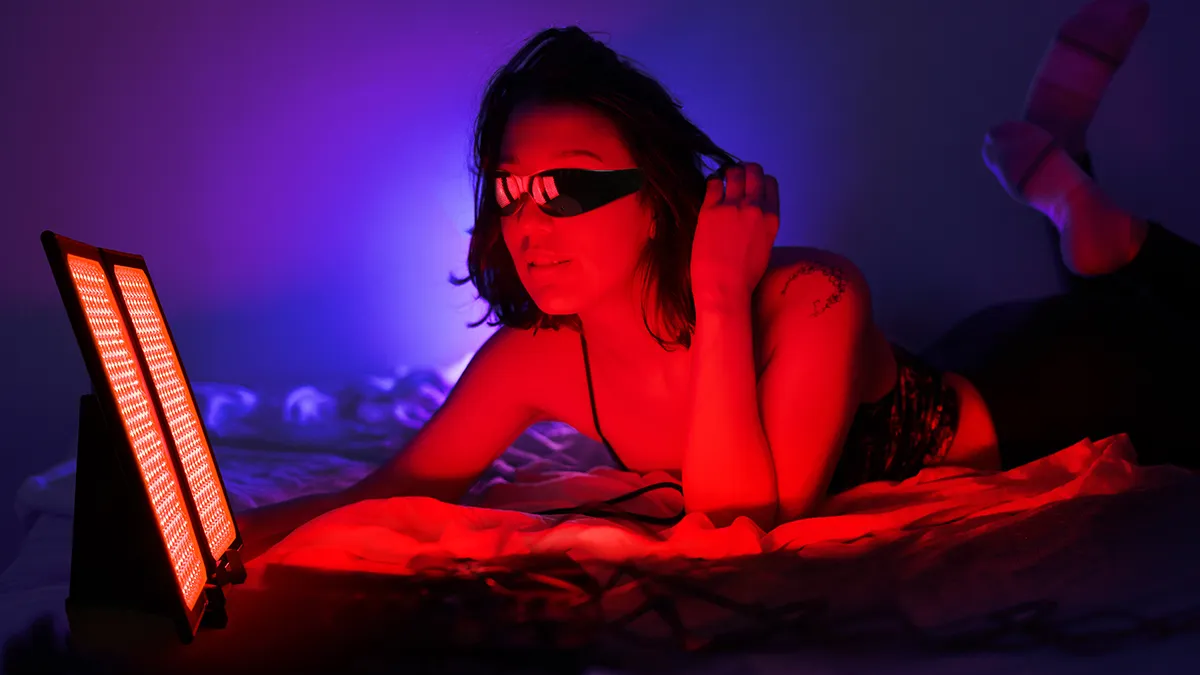
The “better” device FOR YOU might not be the more expensive one if you don’t need it. Your current life circumstances may require you to move around; you may have limited living space; or you may care more about systemic effects than just a bit more snatched face. We’ll cover all of this.
No device - a panel, face mask, wand, hair brush, or helmet - is magic. None replaces an anti-aging lifestyle, but all can be useful tools when we understand what they can realistically do, and what they absolutely cannot.
So let’s talk about the science in a way that will not underestimate and insult you. Let’s look at the raw practical differences of red light panel vs mask, red light community opinions, and the important distinction between a device that fits your life pace, goals, and intentions, versus one that will end up collecting dust beside your abandoned yoga mat, micro needling device, and yogurt maker (nooo, why would you think this is from personal experience?!).
What Does Red Light Therapy Do?
The Micro Level
What does red light therapy do under the microscope? The short (and the most important) answer is mitochondria stimulation. In every cell of the body (except red blood cells, for reasons that will become obvious soon), there sit these nanometric oval or bean-shaped organelles that you may remember from elementary school biology class. If you’ve forgotten all else, remember they are the powerhouses of the cell, a place where energy (ATP) is produced that allows your cell to live, thrive, and repair. The proposed mechanism involves stimulation of cytochrome c oxidase, which is a part of the mitochondrial respiratory chain, aka how your cell breathes. And the cell needs to breathe to make energy fast and efficiently (well, it doesn’t really have to breathe; it can also ferment sugars for a bit of energy, as cancers do). Improved ATP production can influence inflammation, oxidative stress, circulation, and cellular signaling, all of the things that start glitching as we age.
Everything officially alive produces ATP (adenosine triphosphate), and, fun/grim fact, cyanide actually works by stopping ATP production in the mitochondria. What we now consider just a part of our cell was once a fully independent bacterial organism, roaming around, chilling, and consuming oxygen. A couple of billion years ago, the bacteria got sucked in by some other cell, and instead of destroying it, the cell ended up forming a partnership with the bacterial species. In this symbiosis, the cell protected the mitochondrial bacteria, while the bacteria provided an insane amount of energy to the host cell by burning food and oxygen. Btw, that’s why red blood cells don’t have mitochondria. Their job is to transport oxygen, and basically, if they had mitochondria, they would get high on their own supply.

This is the deep cellular level on which red or infrared light therapy works safely (spanning wavelengths between 630nm and 850nm):
- red light: around 630–660 nm
- near-infrared light: around 810–850 nm
In addition to stimulating more ATP production, light therapy also increased NO (nitric oxide) levels in tissues during and after the sessions, resulting in vasodilation, meaning exposure to therapeutic wavelengths widens the blood vessels and increases blood flow to targeted areas, bringing extra fresh oxygen and nutrients to tissues.
The Macro Level
What does red light therapy do in the real, 3D world that our body and person inhabit and interact with? The visible changes are the cumulative effects of all of the cellular-level improvements, which is logical.
A cell hungry for energy will have only one goal - to survive. A cell with abundant energy will not have to tighten the belt and once it covers the survival minimum, will still have quite a lot left over to invest into repair and rebuilding of damaged structures, proper replication, and optimal function, rather than barely scraping by. This is why consistent red light therapy shows results that we can see and measure. Clinical research has shown promising effects for:
- skin rejuvenation and collagen support
- faster post-op wound healing
- soothing inflammatory acne (often combined with blue light) and fading acne scarring
- pain management and muscle recovery
- helping control inflammatory conditions
But here is the kicker. Not all red light therapy devices were designed for the same purpose, and results are not uniform, regardless of whether we‘re talking about a red light panel vs. a mask, or comparing one red light mask to another. Dose matters. Wavelength matters. Treatment consistency matters. And device quality seriously matters, unless you’d like to spend a couple of hundred bucks on just some pretty lights. It is important to get more information on any skincare technologies you’re planning to invest in because marketing loves to flatten nuance into “boosts collagen instantly.” It is not that simple.
Red Light Mask vs Panel: The Core Difference
The key difference that will determine your choice of a red light panel vs a mask or vice versa is the body area that requires treatment. And this is your starting point, always.
- A red light mask is designed primarily for facial treatments
- A red light panel treats a larger surface area of the body, which varies from face and bust to full torso/back or even full body.
The real comparison isn’t only about coverage and personal goals. We’re not robots that make completely rational decisions and are all, in fact, quite lazy. This is not throwing shade on humanity; it’s just the reality of biology that we’re good at finding an easier way to do things and skipping the extra steps. We’re really savvy like that because the brain and body love to conserve energy, stockpiling it and still waiting for that prehistoric sabretooth tiger to strike and threaten to take us out of the gene pool.
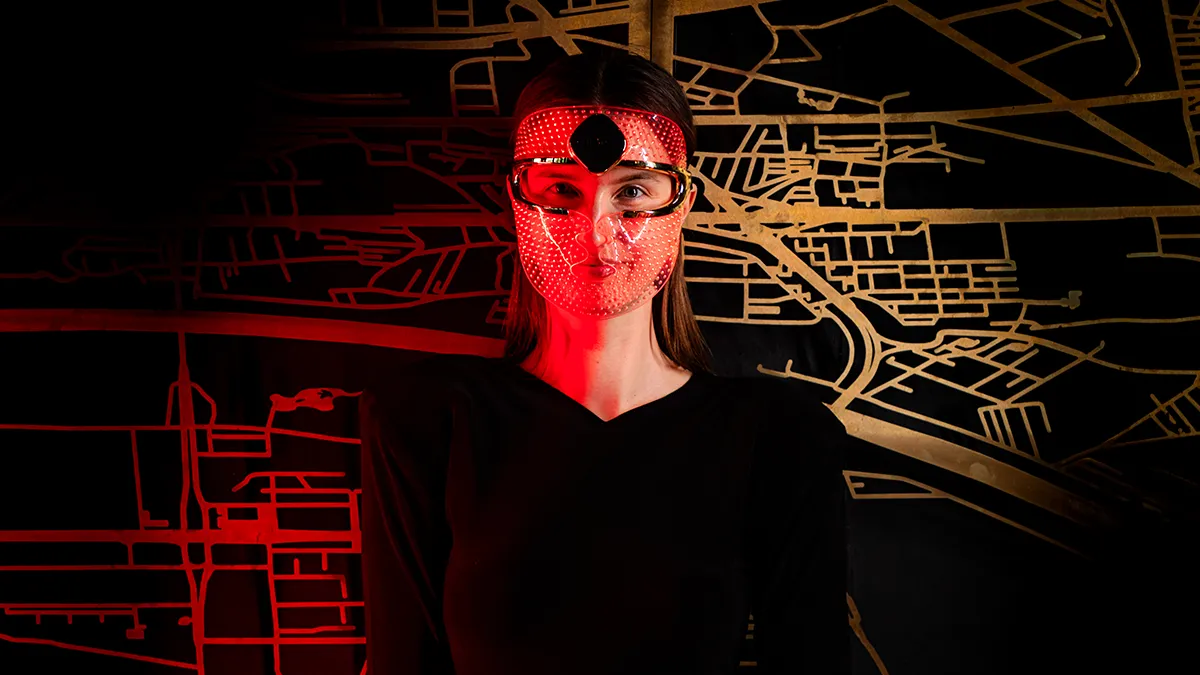
The choice of red light panel vs a mask is also about convenience, about distance from the skin, about consistency, or whether your current life constellation realistically allows you to be stuck in front of a panel for 20 minutes, or you need to run around a toddler. These small things matter more than people think in actually using your device and making it a part of your lifestyle and routine.
Red Light Masks
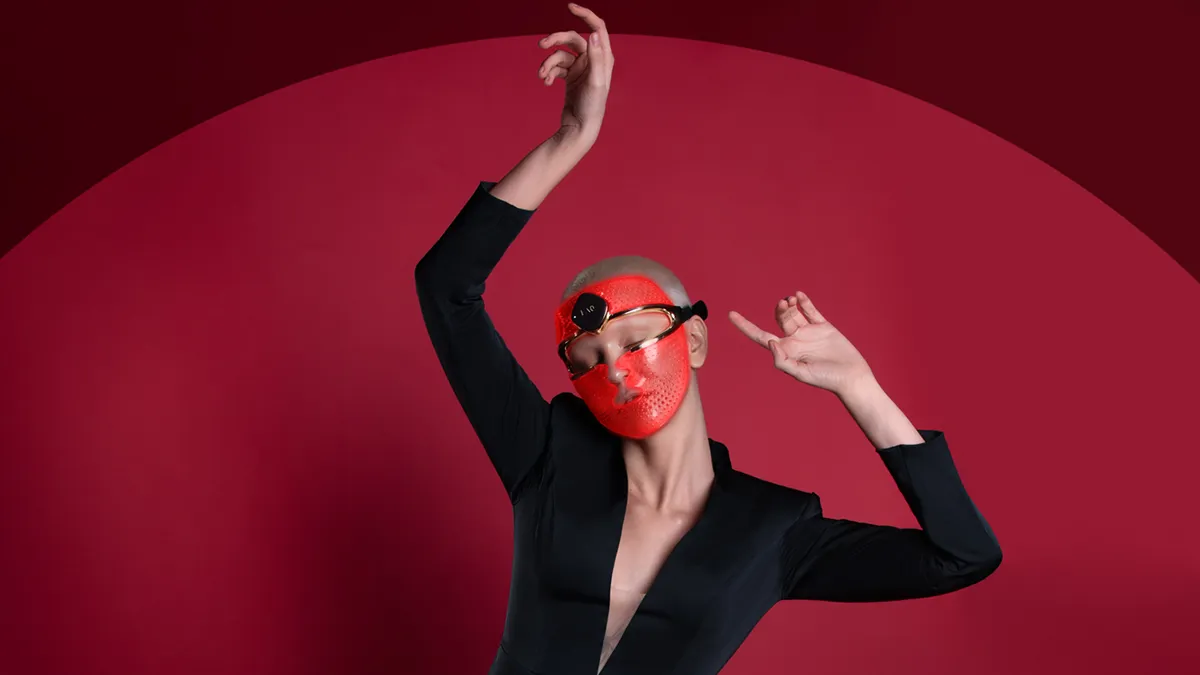
Red light masks are very safe and convenient (and will make you feel like a cyber punk princess). They sit directly on your face or very close to the skin and are designed for localized treatments (although some brands have expanded red light therapy to the neck and hands; this is worth checking out). You’ll also find brands that offer complementary skincare developed to be activated by red light therapy, improving the results of the treatment.
Most face masks are:
- lightweight or wearable
- have lower power than panels
- designed to serve purely skincare goals
- easy to use, hands-free, and wireless
Typical skincare goals when you might opt for a red light mask instead of a panel are:
- fine lines and wrinkles
- acne or acne scarring (usually combined with blue light)
- post-inflammatory redness
- skin texture issues
- mild hyperpigmentation
Good face masks will also offer additional wavelengths, primarily NIR for anti-aging purposes, as well as blue, green, and amber.
Advantages of Red Light Masks
Ease of use and convenience
We love convenience, and just strapping on a lightweight, wireless LED mask and pushing a button is very easy. You can also move around and go about your day, scrolling, doing laundry, reading, or playing the piano. You’re basically free to live your life as you’re doing a treatment.
Even facial coverage
The shape, straps, and direct placement ensure even light coverage across every millimeter of the face and consistent quality for every treatment, helping standardize exposure. Basically, if you’re going to be strapping it on your head, there is basically no margin for mistake, the fit will always be pretty much the same, and it's foolproof.
Targeted goals
Red LED face masks are not designed for more serious things like muscle recovery or pain management, but give results in specific skincare concerns:
- wrinkles
- acne
- redness
- facial inflammation
A randomized controlled study took 76 people with facial wrinkles and treated only one side of the face with LED light therapy twice a week for 4 consecutive weeks. The participants were divided into four groups: one got 830nm near-infrared light, the other 633nm red light, the third a combination of both, and the fourth a fake treatment (“sham light”) for comparison. The study was double-blind, so neither the patients nor the scientists knew who received the real treatment.
The results showed up to 36% reduction in wrinkle measurements and up to 19% increase in elasticity, and the results were not just visual but structural. All treated groups (the first three) showed a benefit of stimulated fibroblasts, increased collagen production, improved elasticity, and reduced markers associated with skin aging.
Limitations of Red Light Masks
Lower power output
Most face masks, even high-quality ones, operate at lower irradiance than panels simply because of their purpose. This does not mean they are not effective; it just means they don’t need to be as strong, as they are targeting superficial epidermal tissues rather than muscle and joints.
Limited treatment area
Yes, you’re limited to just a face treatment, but this is not a problem if that was your goal from the beginning. But keep in mind, if you had an idea to wrap a face mask around an aching knee joint, this will not work. A mask designed for the skin is not strong enough to reach a joint.
Fit issues
Well, yes, this is the reality of bodies being different and an impossibility of producing a universal fit, but some brands have done really well in this regard, like the new FAQ ™ 200 line, where the brand studied 10,000 faces to find a middle ground for the largest possible percentage of clients. But yes, not all masks fit all faces well. Gaps can create uneven exposure, especially around:
- jawline
- temples
- under-eyes
And some hard-shell masks are surprisingly uncomfortable. You’re free to dance to your own tune here, but I’d warmly recommend taking a soft, or at least somewhat malleable face mask that will not entomb you.
Red Light Panels
Panels are larger, more powerful (and expensive) devices intended for exposure of large portions of the body or the full body. The sizes vary from small tabletop facial panels, no bigger than a vanity mirror, to medium body panels that fit the size of a torso, to large full-body systems that’ll light up the room and make you feel like you’ve just opened the gates of hell, while also giving you unreasonable ideas of self-grandeur.
Typical goals of a red light panel go far beyond just aesthetic pursuits that govern the red light mask. Panels are more focused on:
- deep skin health and structure
- muscle recovery (a favorite amongst professional athletes and overzealous amateurs)
- joint pain, which is usually linked to some sort of inflammatory process
- inflammation support in general in various areas and tissues
- full-body wellness routines
- circadian rhythm and mood regulation
Advantages of Red Light Panels
Higher irradiance
A red light therapy panel generally produces a stronger light output than any wearable mask, regardless of the quality of either. It is just how it is. More power also means:
Potentially deeper penetration (although, don’t be fooled here, penetration depth depends a lot on the wavelength, such as red light vs NIR, not just power. For example, NIR penetrates deeper than red light, which penetrates deeper than blue light.)
Shorter treatment sessions, more power means that mitochondria will absorb the energy they need faster, so you can be done in 10, rather than 25 minutes
Full-body treatment
All things considered, even if you’re just looking for a facial treatment now, it is logical to think about the future and invest in a device you can use on multiple areas and for various benefits down the line, such as muscle soreness, inflammation, insomnia, and chronic pain…

A red light full body panel can expose the face, neck, chest, back, legs, scalp, and joints all in one session, and they’re versatile enough to hit skin issues, body pain, tension spots, injuries, scalp, and inflamed areas.
Limitations of Red Light Panels
Larger size
Size is definitely an issue. If you choose large wall-mounted panels, you need to consider the space requirements. But there are also modern panels designed to be portable, lightweight, and easy to use, that will not take up more space than a thin laptop, which are worth considering if space is an issue for you. The power may sometimes be more intense in wall-mounted, plugged-in panels, but this gap is narrowing in newer thin-panel models.
Price
Red light panels are more expensive than most masks on the market. So if you’re on a budget and your face is the most critical area you’d like to treat, an expensive panel may be overkill. No need to pay more to get a device that has functionalities you will never ever use (remember this when buying anything in your life, especially phones, general gadgets, and doo-dahs).
Imobility
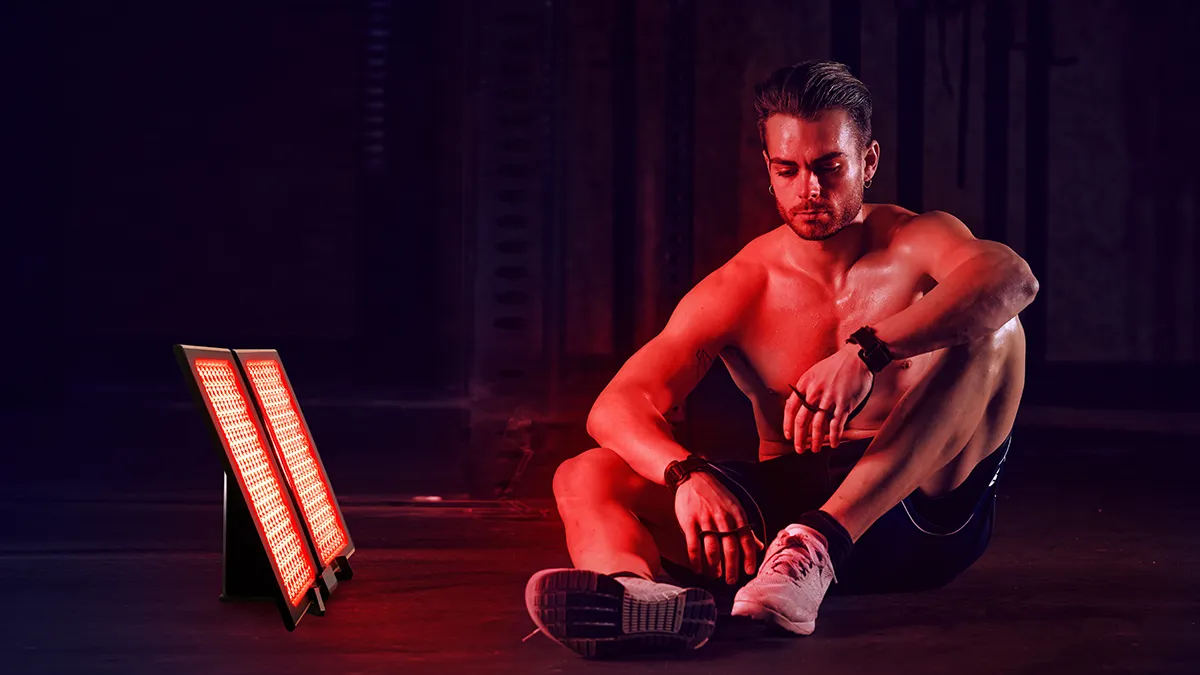
If you’re in front of a panel, you can move a bit; there's no need to be a marble statue, but you should stay in an effective window of 6-18 inches for 10-20 minutes. So you can do some minor movements, like painting your toes or reading a book, but a red light panel isn't wearable, and you’re not going to be mobile for the duration of the treatment. You might care for this or not, but anyways, this is to be taken into consideration.
Are Panels Better for Skin?
Not automatically. We tend to see the world through the lens of “If little is good, more must be better”. But in life and light therapy alike, there is (ironically) a lot of gray area, and things are not this simple and linear.
Higher intensity is not always better in photobiomodulation therapies because a cell is a living thing that shows a biphasic dose response. This more or less means that there is a Goldilocks zone, a sweet spot where the benefits are ideal, rising with increased therapy, then plateauing and beginning to drop the further we intensify the treatment. So, if you were ever wondering, "Can you do too much red light therapy?" Yes, you can. More photons do not give you infinite collagen improvements; biology has limits.
Red light panel vs mask for wrinkles? If you’re just looking to address fine lines, mild texture issues, post-inflammatory redness, and maintenance skincare, a quality LED mask is often enough for your needs. But people wonder, “Are panels better for anti-aging?” trying to justify the heftier investment. Presuming this “anti-aging” primarily refers to the signs of aging on the face, not necessarily longevity, panels are not automatically superior simply because they’re larger or more expensive. If you’ve chosen a weak panel, are not using it at the right distance, long or consistently enough, a well-designed mask used regularly will do more good. I know, I know, a deeply unsexy answer, but an honest one.
So if you’ve kind of noticed the cruel, cruel heartless gravity pulling your face ever more towards the center of the earth like your cells were freakin’ Jules Verne, if you’re looking at the pictures from a few years ago with nostalgia, staring at the freshness you seem to be rapidly losing, if there is a hint of jowls forming or the crows have stomped your periocular area with their feet, red light therapy may be ideal for you, through whichever medium you choose to use it. But keep in mind to manage your expectations and that there are some conditions with which you should be careful with red light therapy.
The change with at-home red light devices will not be as fast or as dramatic as cutting into your flesh and burning off a few skin layers, but you also won’t bleed, blister, need to take time off work to recover, or risk infections or complications. To help you squish down a lot of information into simple, actionable steps:
Choose a red light mask if:
- your concerns mostly orbit around facial skin and aging
- you want convenience, and can’t really be bothered to make large lifestyle/schedule changes, regardless of how much you’d like to look younger and fresher
- you struggle with consistency when introducing new routines (we all do, sister)
- you prefer shorter, passive routines that will allow you to do your own thing
- you travel often and need something practical enough to safely pack without a second thought
Choose a red light panel if:
- you also want neck/chest/torso/leg/back treatment
- you want stronger irradiance because your issues are more medical than aesthetic
- you’re interested in body-wide benefits, systemic effects, and general wellness
- you’re a minimalist and want a single multipurpose device
- have trouble sleeping, are in need of muscle recovery, are inflamed, have pain locally or systemically
If you’re going to take anything from this, remember that a mask is essentially a skincare tool. A panel can become a broader wellness device. This is the core, the money shot, and the source that determines all your decisions and choices downstream, like power, shape, price, convenience…
What Do Users Say?
If you spend enough time reading “red light mask vs panel” social media and forum wars, patterns start to emerge. Sure, sure, we’re all different, unique snowflakes with their own ideas, opinions, hopes, expectations, and resentments to this and that, a never-to-be-again constellation of individual circumstance and character, but we’re all people with similar biology. And when it comes to all major discussions on a thing that works with and not against human biology, once you read enough of it, the key messages are not that hard to see and boil down, although individual stories may be variations on a theme.
People who prefer red light masks say:
- “It’s easy, I actually use it consistently.” (with comments on how this consistency is the key factor to seeing any change; nothing works if you don’t use it, not muscle, not brain, not red light therapy)
- “It fits into my anti-aging skincare routine.” This fit relates to not having to change a lot; change is difficult, as anyone who’s ever tried to change some trivial habit knows; in the case of masks, you pretty much do your regular routine and just strap on a mask when you’re done and continue doing housework, chilling, chopping veggies, talking to your goldfish… whatever rocks your boat.
- “It’s easier mentally.” No need to constantly worry, plan for specific blocks of time when you’ll be a motionless sphinx, pay attention to proper distance… just fewer things to worry about, especially if you get a mask that charges up and is used wirelessly, people love them wireless.
- “I saw gradual improvements in redness and texture.” Here it is, the expectation management angle; please, please, please, don’t buy the “instant facelift” marketing talk; red light does not work like that; cellular mechanisms take time to rebuild and restore to a point where the change in skin is visible, you can notice in a few weeks or months, depending on your device specs and how consistent you are.
People who switch to panels (a lot have owned masks prior) say:
- “I wanted more power.” There is a large percentage of red LED panel owners who started with a face mask, wand or some other form of light therapy; this is actually a smart move - testing out the tech before upgrading to a more pricey version, and most users ended up getting their red light panels from the same brands where they got the mask they were satisfied with)
- “I started using it for recovery, too.” These comments soar just as spring comes along and people realize that the beach for which you need a body is far closer than it felt a few months ago, which intensifies (or restarts) the gym sessions.
- “It replaced multiple devices.” Ideally, we’d all be smart enough with our money to get multipurpose objects that are easily stored and respond to real (not imagined and consumerism-manufactured) needs; minimalism saves more money than we think, we need what we need and nothing more.
- “I noticed benefits beyond skincare.” These are the people who splurged initially on a panel with purely aesthetic goals, but soon realized other things like improved sleep, better hair quality, less joint pain…
And there’s a recurring sentiment that’s worth paying attention to: Many users start with a mask because it feels approachable. Many eventually upgrade to a panel for versatility. That doesn’t mean the mask failed. It means their goals expanded as they got familiar with the technology.
Wraps vs Panels?
What is the difference between red light therapy wraps and panels? Wraps are flexible devices designed to contour around body parts, and a main distinction between a red light wrap and a panel is that a wrap is precise, while a panel is expansive.
Wraps are sturdy yet pliable sheets that can be secured to specific isolated body parts like knees, waist, shoulders, ankles, and neck. They are also convenient, portable, and mostly used for targeted recovery. By power output, most of them sit somewhere between masks and panels and are most useful to target:
- localized pain management
- joint inflammation
- localized tissue recovery (after an injury or an operation)
Device Suggestions
First, we'll provide an overview of an entire red light specialized collection and where you can find these on the official FAQ™ pages, and then I'll focus more on the masks and panels, since you've come here to learn more specifically about red light panel vs mask stuff. Here is the entire collection (there is also some complementary skincare, but you can find this easily on the page next to the device of your interest, so no need to go into that).
FAQ™ 100 Collection
- FAQ™ 101 RF & Red Light Wand For Face
- FAQ™ 102 RF, EMS & Red Light Anti-aging Wand For Face
- FAQ™ 103 Diamond-adorned RF, EMS & Red Light Wand
FAQ™ 200 Collection
- FAQ™ 201 Silicone LED Face Mask
- FAQ™ 202 Anti-aging Silicone LED Mask
- FAQ™ 202 plus LED face mask
- FAQ™ 211 Red Light Neck & Décolleté Mask
- FAQ™ 221 Anti-aging Red LED Hand Mask
FAQ™ 300 Collection
- FAQ™ 301 LED Hair Strengthening Scalp Massager
- FAQ™ 302 Laser & LED Hair Regrowth Scalp Massager
FAQ™ 400 Collection
- FAQ™ 401 Dual Microcurrent LED Toning Device
- FAQ™ 402 Dual Microcurrent Red LED Toning Device
- FAQ™ 411 Microcurrent Red LED Body Toning Device
FAQ™ 500 Collection
- FAQ™ 501 Full Spectrum Red Light Therapy
- FAQ™ 502 Full Spectrum Red Light & NIR Therapy
FAQ™ LED Light Therapy Panels
- FAQ™ LED Panel (Single)
- FAQ™ Dual LED Panel
And here is a close-up on the relevant devices:
FAQ™ 201 Silicone LED Face Mask
Ideal for those who’d like to rejuvenate completely passively, and even holding a device is a hard nope (no judgment here).
Just like the 01 in the 100 collection, the 01 in a 200 collection is an entry-level device (for overachievers) featuring red, green & blue LED light therapy.
You can get red light therapy from so many brands now, so you have no reason to go for this LED mask specifically - unless you are ok with being grounded for the duration of the treatment. From what I've seen, the wireless ones are also rigid, more like a hard or mildly flexible carnival mask of a Stormtrooper. FAQ™ 201 is made of something called flexi-fit silicone. It is translucent, ridiculously lightweight, and will lie perfectly on your face, feeling like a second skin.
No wires, 6000 light points that pulse a 1000 times per second, light as air, and with open mouth and eyes (which are protected by an inbuilt shield for eye safety). If you're looking for a perfect LED mask, are happy with RGB wavelengths, and totally into getting things done rather than doing things, this is a huge recommendation.
FAQ™ 202 Anti-aging Silicone LED Mask
Ideal for passive rejuvenation, and if you want more skincare options in one product than just anti-aging, and you feel posh saying “near-infrared”.
It's all quite logical if you look at the entire collection as a whole. The 02 of the 200 collection is also full-spectrum LED anti-aging, but here we're upgraded into NIR (near-infrared) + 7 wavelengths. Human eyes can't see pure infrared (unlike some frogs, salmon, and vipers), but NIR is the wavelength we can still see, and it penetrates deeper into the skin than red light therapy. The 202 is more advanced with its 3000 LED pulses per second. Locked into our human 3D grid and timeframes, 3000/sec is an abstraction, like trying to grasp infinity.

FAQ™ 202 plus LED face mask
Ideal for those who have a stubborn, angry 11 etched into their mid-brow.
FAQ™ 202 plus is an upgraded design in response to the wishes of the people. The brand took everything that people liked about the 202 LED face mask and applied realistic customer desires. Now the FAQ™ 202 plus has 50% stronger light and more LED points, including 9 LEDs in the forehead diamond to iron out those very stubborn deep frown lines, bringing the total to 634 LED light points. It also has 8 LED wavelengths and flexi-fit silicone that molds to your face shape for the most even light coverage possible. Some very smug, clinically-proven results include reducing wrinkles by 32%, reducing acne by 48%, and increasing elasticity in 2 weeks. Two weeks from now, you can be on your way to having a face from a few years ago.
FAQ™ 211 Red Light Neck & Décolleté Mask
Ideal for the hints of turkey neck gobble-gobbling its way into your life and fine lines on top of the chest.
This is a branch-off from the Face LED Masks FAQ™ 201 and 202. It jas the same functionality, but is adapted for the neck and the top of the chest, which are so ready to spill the beans of our age (even if we've managed to save face). The skin on the neck and, let's be all French about it, décolleté, is still quite thin, sensitive, and mostly unprotected by clothes for much of the year, and it gets hit by the elements and UV radiation just as hard as the face does. FAQ™ 211 kept the 8 light colors, including NIR, and is also ultra-lightweight, wireless, and made from the same flexi-fit silicone, but in a turtleneck shape. Plus, you’ll look like a futuristic SF duchess. Not a bad look. It might even become an heirloom in your family.
But on to the more practical info. The mask has a little adjustable necklace-like chain and is reversible. So, if you've got those annoying upper backne, set it to bacteria-killing blue and hit those buggers with all you've got through the 761 points of light. For those unwilling to experiment and unsure of how to use the technology (or simply lazy) but demanding, you can also find some preset treatments in the app.

FAQ™ 221 Anti-Aging Red LED Hand Mask
Ideal for those who've looked down and suddenly saw granny hands in their lap, and their granny was not in the room.
We forget them, I know we do. We think of hands so much as tools that chop, caress, and type emails, that we only remember them when the manicure lady scolds us, when they get really dry or cracked in winter, or unpleasantly tight, like they're leather gloves a size too small. This means the skin barrier is breaking down, opening the door to premature aging. Ideally, we wash our bodies daily, our faces twice a day, but our hands dozens of times a day. It's no wonder hands age so fast.
FAQ™ 221 works the same as the 211, but was fitted to the hand like a top-sitting half glove with open palms. I can see Mr. Jackson moonwalking across the stage in these, if he were still with us. It features 623 points of light and is fastened to the wrist with a bracelet-like gold chain. All of the other specs are the same; you still have 8 light wavelengths at your disposal, but I believe you came here for the anti-aging benefit, so red and NIR LED light will fit like a glove. You can even slap someone while treating, and it will stay put.
FAQ™ Red Light Panel (Single) & FAQ™ Dual Red Light Panel
Ideal for those who just want it all (in one) and then a double.
We can do the panels together because all functionality remains the same; you simply get double the lights in a dual panel (512 in a double vs 256 in a single), but it won’t matter much which one you get. it depends how big a surface you wish to treat at once.
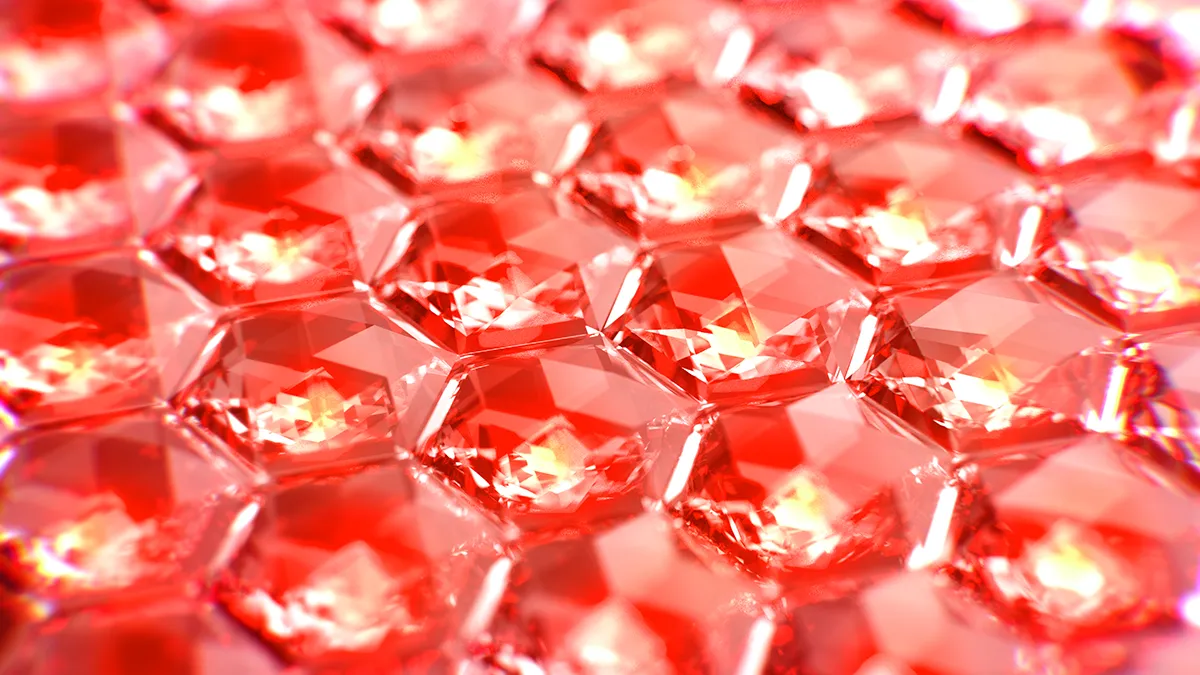
But why are these LED panels so special when everyone and their aunt can find 10 brands in a 1-second search? These are more powerful due to a simple design intervention. The lenses above the LED diodes are usually flat or slightly curved, but FAQ™ LED panels use diamond-shaped lenses. If you've ever looked at a diamond (a girl needs a best friend; mine is a cat, no diamonds), you've noticed how light refracts in so many angles (although real diamonds don't shine like our LEDs here, but rather refract received light… Rihanna was wrong, but we’ll still sing along). This is what these innovative lenses do. Instead of a single-angle vertical illumination, you get amplified, dispersed light that now reaches multiple angles.
Red Light Panel vs Mask Final Verdict
So when all is said and done, and the cows have come home, who wins in the red light panel vs mask duel? Neither, or rather, both win. It’s a draw, completely dependent on what you want and need.
- for targeted facial skincare → a mask
- for full-body versatility → a panel
- for convenience → a mask
- for power and coverage → a panel
Neither device is inherently superior to the other one, as the comparison is pretty much void, since they were not created for the same purpose. If you want to go off-road into wilderness, a canoe is a very bad choice, and you’ll just impotently wobble on the ground, but it works quite well on a river. Sort of like this. They’re different tools built around different uses, but the biology of red light therapy, therapeutic doses, and effective wavelengths, biphasic cell response, consistency, and the real time necessary for the body to rebuild what has been deteriorated are universal to both devices.
When you choose between a red light mask and a panel, choose based on your current reality and circumstance, and your willingness to commit a few times a week. See yourself as you are, not as an idealized superhuman who has time to wake up at 4 AM to journal in linen and hemp shoes in front of a panel, does yoga at sunrise, meal preps everything (organic) at home, and religiously meditates for an hour, before talking to our sourdough starter about ancient civilizations. Don’t buy the device you won’t use; that’s the most expensive kind of device. If you’re unsure, start with a mask and move on once you’ve got this routine down.
The best red light therapy device for you is the one you will use consistently, correctly, and without turning it into a stressful daily obligation. Self-care should be the best part of your day, not another chore on your to-do list. We hope this run-through helped you make an informed decision. Till next time, stay cool, curious, and enjoy living in your gorgeous skin.
Pre-order LUNA™ 5 LED + 5 GIFTS
28 Sept - 12 Oct
What is LUNA™ 5 LED? Now in its 5th generation, the fresh LUNA™ 5 LED fuses new technology into itself - red, NIR, deep NIR, and blue LED light therapy - turning your daily cleanse into a treat(ment).
Facial cleansing brushes are hardly breaking news in the beauty world, but a facial brush 35x more hygienic than nylon, with up to 8000 massage pulsations per minute and LED light therapy (first time with NIR and deep NIR wavelengths), is a revolution. This is no longer just a facial cleansing brush. Because why would it be? Why "waste" cleansing time on cleansing alone when you can pack a little punch with NIR and red-light rejuvenation or anti-blemish blue-light therapy? Don't get me wrong, cleansing is non-negotiable. If you're not willing to wash your face, you may as well do nothing else, because it won't work on clogged, grimy skin, carrying the leftovers of last week's foundation in the pores. LUNA™ 5 LED makes things easier and smarter, checking a few boxes at once with a multitasking mindset.
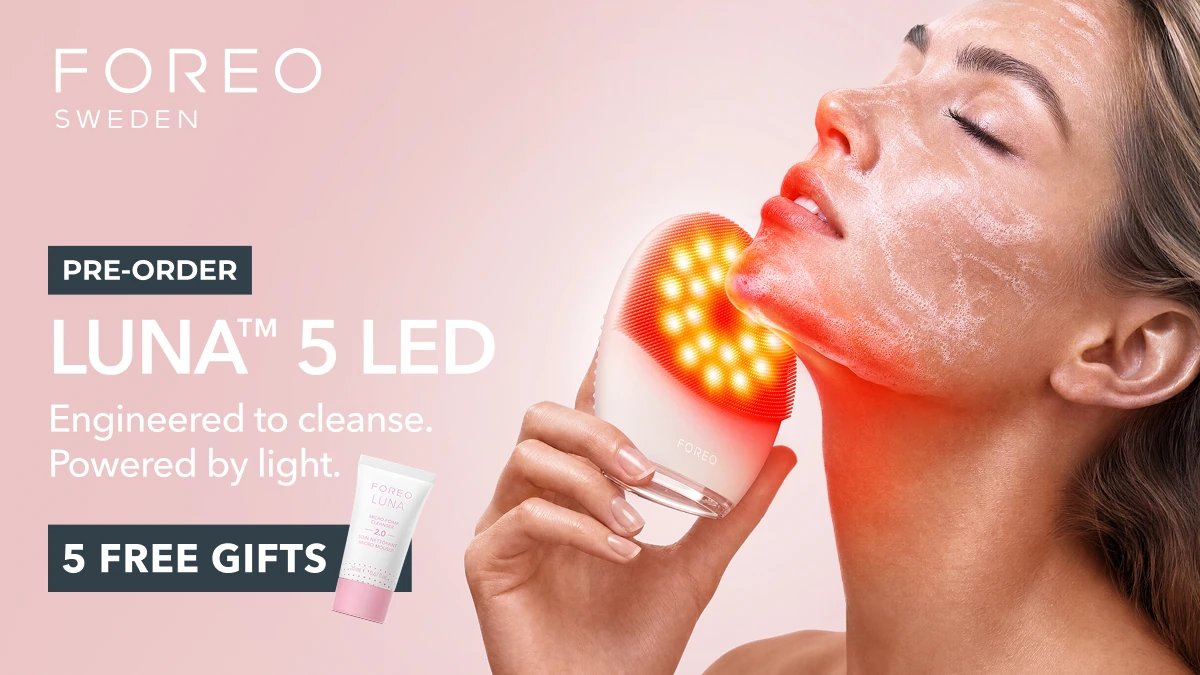
Pre-order your LUNA™ 5 LED from 28 Sept - 12 Oct to secure one from the first batch, and grab 5 fabulous gifts (5 x LUNA™ Micro-Foam Cleanser 2.0, 20mL) for free and enjoy living in your gorgeous skin.



Leave a comment