10 min read
50 Shades of... Discharge. What is Normal?

I know the mixed feelings stirring inside, so first, let’s get one thing clear here. There is nothing gross, shameful, or to be hidden when talking about discharge. It’s about knowing our fantastic body (we are fantastically well-made, aren’t we?) and learning to read the signs of crucial information on feminine health, such as the color, smell, and texture of vaginal discharge. We should have learnt this and started paying attention from our first period way into menopause and old age, but so often 2 AM in our 20s, 30s, and 40s finds us Googling until wee hours after seeing some cottage cheese on our panties. First of all, if you’re reading this in the early AMs, bookmark it and go to bed. Come back tomorrow, girl. There is no better skincare routine and self-care than a good night's sleep.
We're gonna go deep, deep down, reading between the (panty) lines to understand what discharge is and what various discharge colors mean. All of the things that make you lower your voice and get all coy, except with your sister or that one friend. We’ll learn what is healthy, what may be a problem, and what would require you to make an appointment with your doctor (don’t worry, it’s mostly easily treatable, and we all get hit at some point in our lives). Vaginal discharge is a large part of female health. Bo the taboo away. We women should be talking to each other (and our doctors) about this so we can learn from each other's experiences and react better if something goes wrong. The vaginal microbiome is robust but can also be fragile, with yeast, bacterial overgrowth, and infections that thrive in our modern high-sugar diets.

We hope that (if not necessarily enjoy) that you'll learn something from our slippery and colorful conversation here as we explore the huge importance of hues, and that you’ll share the knowledge with other ladies in your life, so we can all take better care of ourselves. And please, throw away all of your synthetic underwear; our lady parts need to breathe.
What Is Vaginal Discharge (Discharge Meaning)?
Discharge meaning, as a verb, is to allow (a liquid, gas, or other substance) to flow out from where it has been confined (vagina in our case, if you've jumped in medias res and are in the habit of ignoring intros); or as a noun - the action of discharging a liquid, gas, or other substance. But if you see just the word “discharge” in any text on women’s health, it refers to the vaginal one.
Vaginal discharge is completely normal, and it would in fact be strange and unnatural if you didn’t have any at all. Dry is not a good look for the she shed. The discharge is a mixture of cells and fluid produced by glands inside the vagina and cervix, all mixed up together and aided by gravity out of our body. Vagina is a self-cleaning organ (so don’t go to town with douches, they may do more harm than good if you disturb the natural balance and pH). The purpose of discharge is protective - helping maintain a healthy vaginal environment, flushing out bacteria and dead cells, and providing lubrication. So it is completely normal and an integral part of reproductive health (and the best freakin’ lubricant out there for fun times).
Vaginal discharge is typically made of:
- Cervical mucus
- Vaginal secretions
- Shed cells from the vaginal lining
- Healthy bacteria (mainly Lactobacillus)
- Small amounts of water and electrolytes
These components working together help maintain a mildly acidic environment (normal pH ~3.8–4.5), which very successfully protects against vaginal infections (the majority of the time).

BONUS: Fun Facts on vaginas (and vulvas)
- Urban Dictionary offers some fun euphemisms like: "hoohah juice," "coochie slime," "clam juice," "pussy paste," "kitty cream," "vaginal gravy," and "panty butter."
- Folklore has many cautionary (and sometimes just weird) tales on female sexuality, and one of the most persistent (and weird ones) is claiming the idea that the vagina contains teeth – Vagina Dentata
- The cells inside the vagina don't contain keratin, which only exposed skin cells, hair, and nails have, making the vaginal cells much softer
- Blood vessels in the vagina actually excrete the clear fluid called a transudate
- If you’ve been wondering: Why do I have so much discharge all of a sudden? ” - it’s mostly just normal fluctuations. On average, a woman of reproductive age will make 1-4 mL of vaginal fluid per day
- After menopause, estrogen drops, and the vaginal cell lining changes. Vaginas become much drier, and you'll lose some of the lactobacilli
- Only about 18% of women can reach orgasm solely through vaginal penetration; most need clitoral play also.
- Vaginas are very elastic and will return to their original shape after childbirth.
- No two vulvas (the outside genitalia) are exactly alike; they differ like faces
What does a normal discharge look like?
We will have normal discharge variations through the cycle, during pregnancy, sexual arousal, and with hormonal contraceptives. Many discharge colors are considered completely fine and healthy. But sometimes harmful bacteria or yeast may disrupt the balance of your inner world. If this happens, the body will react, and you’ll notice changes in color, consistency, or smell. Don’t be squeamish, it’s your body talking to you, and this can all be important clues about what’s going on inside, signaling a potential problem.
Normal vaginal discharge can be:
- Clear and stretchy (common during ovulation, is sometimes used as an additional help with timing when trying to conceive)
- Milky white discharge or white creamy discharge (common before/after ovulation, this is your regular joe)
- Watery clear discharge (can happen anytime in the cycle and is completely normal)
These usually come with:
- A mild or neutral smell
- No itching or burning
- No pain
Gray, green, or yellow discharge
We’ve learned what a normal vaginal discharge is in the previous paragraph, and now we’ll see what you should pay attention to. The discharge color meaning will also be explained in more detail in the paragraph below. It is time to consider a doctor’s visit if the discharge:
- Turns green, gray, or dark yellow (light yellow is most likely just a normal variation)
- Becomes thick and clumpy, sort of a cottage cheese consistency
- Has a strong fishy or foul odor, even when you’re fresh and clean
- Comes with itching, burning, swelling, painful urination, or pelvic pain
- Pain or bleeding unrelated to menstruation
Discharge Color Meaning
Clear Discharge
Clear, watery discharge is normal and happens throughout the month. It often increases around ovulation or with arousal.
You know that wetness you feel forming when your person takes that sweaty T-shirt off and stretches, or uses that firm, resolute voice, handling life like a boss (so you don’t have to right now). Plus, the house is clean, and there is nothing else to attend to as the laundry will take another hour or so. This is the good discharge of squirming in delight and expectation of sexual arousal.
Natural lubrication is always preferred over artificial lubrication. You can use natural substitutes, such as coconut oil, but this may not be as good for sperm motility if you’re trying to get pregnant.
White or Milky Discharge
A milky white discharge - especially early or late in your menstrual cycle - is common and normal. It becomes more noticeable around ovulation or during pregnancy, and is sometimes referred to as leukorrhea, just a fancy name you can throw around as you adjust your glasses.
Stretchy, Egg-White Discharge
This type of clear, stretchy discharge is a sign of fertility and ovulation. The consistency comes from cervical mucus, which helps sperm travel. If you can impressively stretch it between your thumb and index finger, that’s the one. It’s not 100% accurate, but you’re most likely ovulating.
Brown Discharge - Old Blood or Spotting
Why is my discharge brown? Brown discharge often means there is a small amount of older blood that has oxidized, leaving the vagina. It is nothing to worry about and is common at the beginning or end of a period, or after intercourse, especially if you’ve had those lovely, lovely orgasm contractions.
However, brown discharge when you’re not expecting a period - such as between cycles - can sometimes reflect unusual hormonal fluctuations or, rarely, cervical bleeding that you should get checked out.
Yellow or Green Discharge - Possible Infection
Light yellow discharge without odor may be normal, particularly if it changes after exposure to air or during hormonal shifts. Darker yellow or green discharge, especially when frothy or foul-smelling, can help you recognize an infection. Conditions like bacterial vaginosis, trichomoniasis, and sexually transmitted infections such as chlamydia and gonorrhea can cause discharge in these colors.

Thick White Cottage Cheese Discharge - Vaginal Yeast Infection
Cottage cheese is showing up in all the recipes, but seeing it on your panties is far less fun than experimental baking (and pretending to like it on everything). This classic appearance is typically due to a vaginal yeast infection (vaginal yeast infection) caused by an overgrowth of Candida yeast. Besides its clumpy texture, it’s often accompanied by itching, burning, and irritation.
One important thing you must know about Candida yeast is that it ferments sugars for energy and thrives in high sugar environments (like our modern food landscape). Alcohol (basically just sugar with a buzz) and sugar can increase the risk and severity of Candida infections, not only by offering the yeast something to ferment but also by weakening the immune system, promoting inflammation, and disrupting the female body's natural defenses. There’s a reason why we add a bit of sugar when working on pastries with yeast – we’re giving them food.
Gray or Off-White Discharge - BV
Gray is not what you’d like to see, and you may be thinking, “Why does my vagina smell?” (We all have some natural smell that’s actually quite hot to your partner, when mild and neutral). As opposed to green and yellow discharge, grey with a strong “fishy” odor is a hallmark sign of bacterial vaginosis (BV). BV is an imbalance of normal vaginal bacteria, which are supposed to be there in an internal war of good and bad, and bad sometimes wins. It’s often more noticeable after sex and may come with irritation or discomfort.
There is a single reason why this happens, but risk factors are frequent douching (remember the self-cleaning, you don’t need to douche), changing partners often, and some say smoking, but basically anything that lowers lactobacilli numbers and changes the beneficial ph.
Pink or Redish Discharge - Blood Present
Pink or reddish discharge typically contains blood. In many cases, this is simply spotting during ovulation or right before/after a period, or early pregnancy bleeding known as implantation bleeding, when a fertilized egg invades (yes, that’s the proper term) the uterine wall.
However, if you’re seeing persistent red or bloody discharge unrelated to your cycle or the red discharge is accompanied by pain, you should be evaluated by a healthcare provider.
FAQs - Quick Discharge Answers
Q: Is it normal to have clear or white discharge every day?
A: Yes - clear and milky white discharge that’s odorless and changes with your cycle is usually normal.
Q: Why do I have so much discharge all of a sudden?
A: Fluctuations in discharge volume are common with hormonal changes, pregnancy, ovulation, sexual arousal, and birth control; but sudden increases with odor or discomfort may mean you should visit your doctor.
Q: What does chlamydia discharge look like?
A: Chlamydia and other STIs can cause abnormal discharge that’s yellowish or greenish, often with irritation or pelvic pain.
Hue Knew?
And here we are. We’ve officially said the word “discharge” about 173 times, and nobody fainted (imagine if we repeated “moist” that many times).
If there’s one thing to take from our slippery, (moist,) science-backed deep dive, it’s this: discharge is not random, gross, or out to ruin your favorite underwear. It is information, just as your (I’m sorry, it has to be said) poop is. It is communication. It is your body running a beautifully calibrated, hormone-driven system that works 24/7. It’s like those plants you keep in a covered aquarium that thrive, creating their own eco-dome.
Your vagina operates on estrogen, cervical mucus, Lactobacillus dominance, and a delicately maintained pH that most luxury skincare brands could only dream of formulating (ain’t nature great?!). When the color, texture, or smell shifts, it’s not betrayal – it’s feedback, so listen.
- Clear and stretchy? Ovulation is likely around the corner.
- Milky and mild? Business as usual.
- Clumpy, itchy, fishy, neon? That’s your cue to call in the MD backup rather than guessing
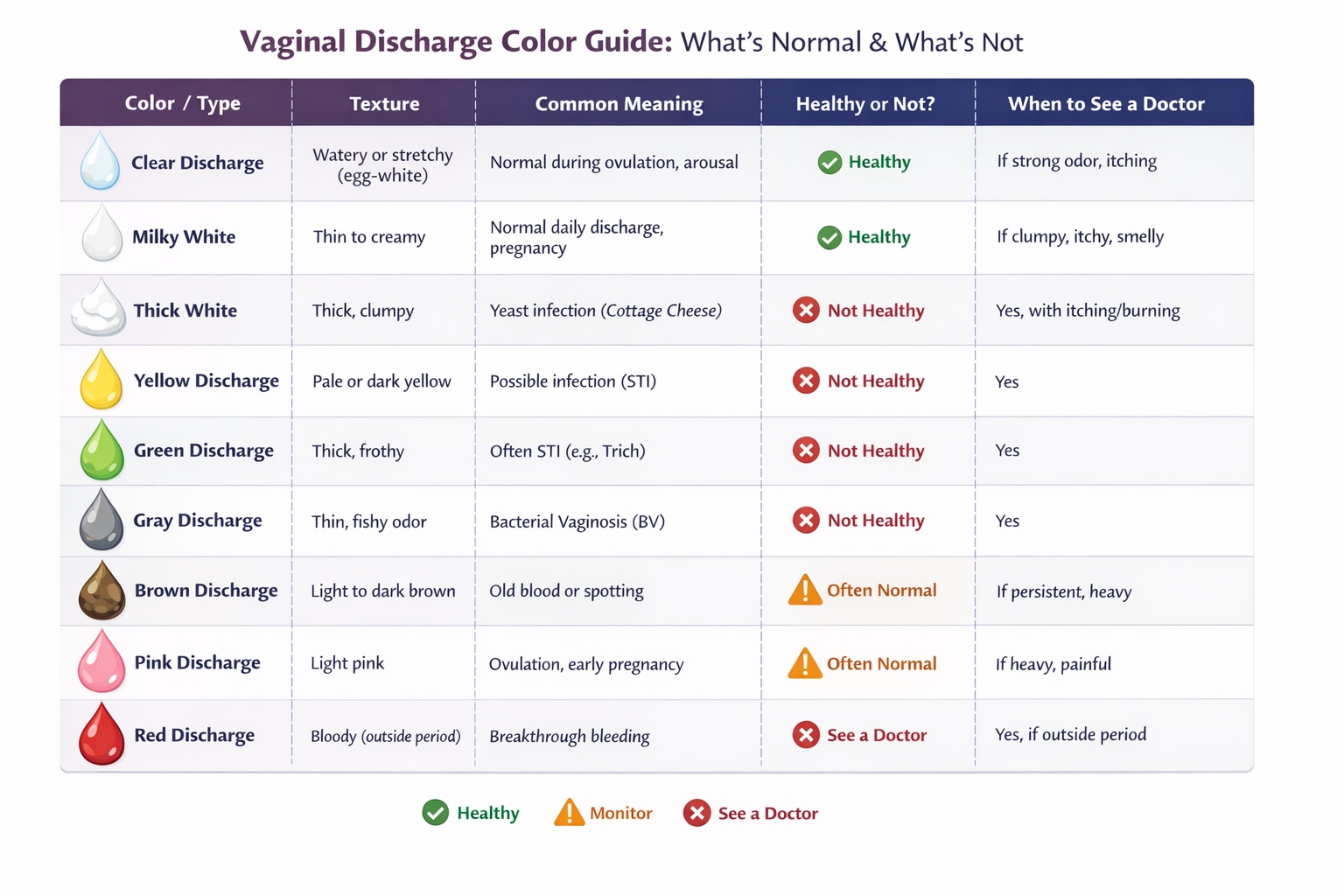
And here’s the part we don’t say enough: being informed about the 50 shades of womanhood makes you powerful. Paying attention is preventative care. It’s body literacy. It’s the difference between fear and understanding.
Yes, it can feel awkward to talk about. We whisper. We giggle. We use euphemisms worthy of middle school. But the truth? Every single woman you know is navigating the exact same spectrum of shades at some point in her life. Yeast happens. BV happens. Hormones fluctuate. Stress interferes. Sugar feeds things you didn’t mean to invite to the party. None of it makes you dirty or broken.
So instead of shame, choose curiosity. Instead of silence, choose conversation. Talk to your sister (from the same or another mister). Your best friend. Your doctor. Normalize it. The more we speak openly, the less power discomfort holds. Feminine health is not a taboo topic. It’s not “too much information” but a foundational health. Understanding what’s normal for you - your patterns, your scents, your textures, your cycle - and learn to read the signs. I hope we colored you curious, gave you some useful info, and that you’ll enjoy living (and having fun) with your hoo-ha, until you’re both old and mad.






Leave a comment