15 min read
8 Glasses of Water a Day is a Lie

How much water should you drink a day?
Well. It’s not 8 glasses. The 8 glasses is a gross oversimplification of a very different statement, shortened to bumper-sticker length.
The advice to drink eight 8-ounce glasses of water a day (about 1.9 liters or 64 ounces) is a snippet from a 1945 pamphlet by the U.S. Food and Nutrition Board, and it leaves out the crucial sentence that immediately followed: “Most of this quantity is contained in prepared foods." This means that all of your fruits, vegetables, soups, yogurt, and beverages count and will make up about a third of your daily intake.
So, the question remains: How much water should I drink a day? An easy, but nuanced question. Many health organizations, like the NHS, recommend aiming for a total daily fluid intake of roughly:
- Between 2 - 2.7 L (91 oz) for most women
- 3 - 3.7 L (125 oz) for most men
Remember, total intake, not just glasses of water, and it heavily depends on your individual circumstances and body needs. Studies left and right have noted that we’re all different and that the amount of water you need varies wildly depending on the time of year, medication you may be on like GLP-1 drugs for weight loss, activity levels, your age, the climate you live in, the type of job you do, and the usual foods you munch on during the day. Avid fruit eaters or soup lovers may not be aware of how much water they’re already getting through their diet, while a healthy individual supplementing with creatine may greatly underestimate their elevated water needs due to the supplement. I am not you; you are not me; we are not them; and they are not him. We may share the same planet and basic biology, but our lives, bodies, constellations of circumstances, and needs are different.
So this talk is a doozy for all my dear (supposedly) dehydrated brothers and sisters, who are told they are drying out on a planet covered with water.
How much water should you drink each day, and are there easy ways to drink more water? A logical, life-sustaining question we’ve all fondled at some wee hour after realizing that the discomfort we’ve been feeling all day is thirst; we just didn’t notice because we were too busy.
Seems kind of silly to have to put any serious thought into something as natural as drinking water. After all, you’ll die without it, but we, responsible grownups with jobs, apartments, and bank loans, can’t seem to figure out a cue of thirst that even a toddler is aware of. Well, toddlers don’t have houses, loans, jobs, or other toddlers and therefore have time to focus on themselves and their bodily needs.
For the sake of argument, let’s presume that most of you are here because you have an inkling that you’re not drinking enough rather than drinking too much water. So let’s go elbow deep, and perfect-10-splash into some info on how to increase water intake. Go get yourself a cool, clinking glass of something (alcohol dehydrates; low to moderate amount of caffeine doesn’t dehydrate - yet another myth), get cozy, and let’s dive in (there will be more wet, lame jokes downstream for sure; ups, I did it again, Britney would be proud).
Why is drinking water so important?
Because you are water, not the Bruce-Lee-be-water-my-friend way of fluid adaptation to life challenges, but you’re actually water. According to Medical News Today, water makes up about 50% to 65% of an adult's body weight, and babies and children have even more. Infants have up to 75%, and preteens up to 65%.
The process of aging is sort of drying out, and the older you get, your body water percentage drops. A large part of your scale number is water weight, but if you eat a lot of processed carbohydrates, you may be even retaining some water that’s making you look puffy and inflamed. This is released once insulin is allowed to drop due to lowering carbohydrates, not snacking all the time, or introducing intermittened fasting to improve metabolic health.
Water is necessary for all bodily reactions, metabolism, and getting rid of metabolic waste. It is in your cells, muscles, and organs, and except for oxygen deprivation, its lack will kill you the fastest. A healthy adult can survive 3-4 days, but the window could be much shorter if you’re in extreme heat, while exercising, or under exertion, which increases sweating and respiration. Water is everywhere, even in seemingly hard structures such as your bones.
What are the benefits of drinking water?
Well, besides staying alive, your body will use the water you ingest to replace the water lost throughout the day through urination, pooping, breathing, and sweating. We’re basically an exchange machine, exchanging things with the environment all the time. Once the water gets in the body, WebMD says it’s used to:
- Form tears, saliva, sweat, and urine. Did you know you can’t form tears if you’re severely dehydrated because the body decides it would be a waste of the remaining water it has? So you’ll sort of dry-cry about being dehydrated.
- Remove waste from the body through urine and bowel movements. Pooping will be responsible for about 200 ml loss of water a day, and you’ll pee out about 800 to 2,000 milliliters (27 to 67 fluid ounces).
Support the brain and body metabolism, aka you’ll be able to think, move, have energy to do things, and keep your mood (more or less) regulated. How much water you should drink in a day will vary greatly here depending on your body size, health, activity level, food choices, and weather.
- Sweating. This is used to regulate body temperature and adapt to environmental conditions by cooling the body.
- Maintaining blood pressure. Water regulates blood volume and blood vessel elasticity. Lower blood volume due to dehydration will lead to blood vessels constricting to compensate, raising blood pressure and preventing dangerously low pressure, called orthostatic hypotension.
- Digestion and nutrient absorption. If you’re dehydrated, you may be unable to absorb certain water-soluble nutrients and end up nutrient deficient. You wouldn’t be able to pass stools, as they would become hard and dehydrated because your colon would absorb all the extra water. Keeping hydrated also allows normal urination, and according to the National Kidney Foundation, long-term dehydration could harm the kidneys.
- Protect cells and tissues. Since these need water to live and function optimally, the body tightly regulates the balance. Every cell and tissue chemically communicates with the cells and tissues around it and needs water to do so, as well as to use the nutrients that come in for metabolic processes that produce the energy of life, ATP, in the mitochondria.
Is dehydration dangerous?
Yes, inadequate hydration can lead to dehydration, which can be mild, moderate, or severe. According to the NHS, dehydration symptoms can range from feeling foggy and fatigued to full-blown organ failure, because all cells and chemical reactions in the body require water. That is why we have so much of it. These are symptoms of dehydration to pay attention to:
- Mild dehydration: That's a loss of 1-2% of body weight of water weight. Here you may experience thirst, dry mouth, headaches, fatigue, reduced concentration, dizziness, and darker urine, and may feel like something is off with your mood, memory, and physical performance. Btw, most headaches are due to mild dehydration. Drink some water before you reach for a painkiller.
- Moderate dehydration: Here you'll feel general weakness; your heart may start to race for no apparent reason, blood pressure will drop as the blood volume decreases and therefore the pressure on the blood vessels, disrupted electrolyte balance can cause muscle cramps, and you'll see constipation because the bowel can't move the hardened stool, and decreased urination.
- Severe dehydration: Go to the ER or call an ambulance. This is a medical emergency accompanied by confusion, disorientation, fainting, rapid breathing, sunken eyes, an inability to urinate at all, dangerously low blood pressure, kidney injury, seizures, shock, and, if left untreated, can be life-threatening.
Signs you should seek medical attention for dehydration
- You have persistent vomiting or diarrhea that prevents you from keeping fluids down.
- You develop signs of significant dehydration such as confusion, fainting, a very rapid heartbeat, or little to no urination and very dark urine.
You'll be given intravenous fluids to restore the balance.
How much water should you drink in a day?
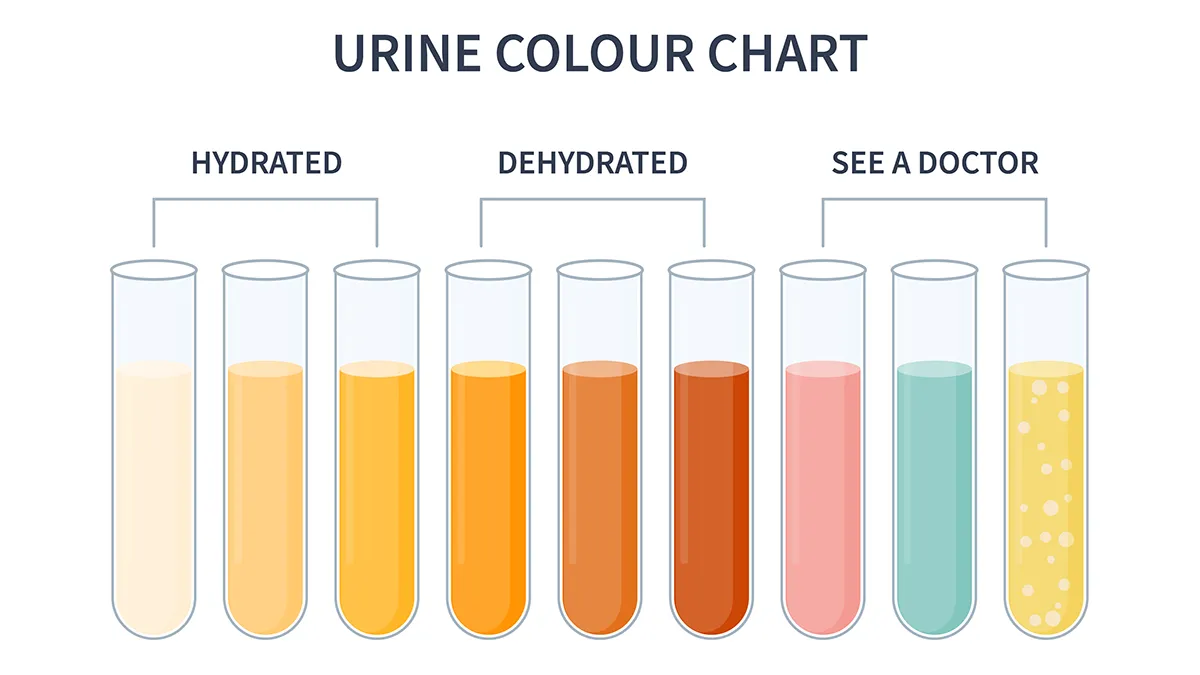
Here is a little context-dependent hydration guide, rather than the naked one-size-fits-all numbers. Even our in-context recommendation may not fit you exactly. You should sip throughout the day, pay attention to the thirst signal, and check your pee color as the best measure. We’re aiming for pale yellow pee, not translucent (overhydration; may mess with electrolytes) or dark yellow urine (dehydration; overly concentrated urine). So, how much water to drink a day in these circumstances (mind you this is the total hydrating liquid intake that includes food and other beverages):
How much water should you drink while exercising?
It is logical: if you move more, you sweat more; the more strenuous the activity and the higher the temperature where you’re doing the activity, the more fluid you’ll lose through sweat. With heightened activity, women may need 2.5–3.5 L (85–120 oz) per day, while men may need 3.5–4.5 L (120–150 oz).
If you’re doing some serious training like HIIT rather than half an hour of light weights in an air-conditioned gym, add 400–800 mL (14–27 oz) of water per hour of exercise. So an hour of moderate exercise will require only about 400 mL more. No need to guzzle down gallons. If you’re doing a dry (the irony) run for a marathon and have been running for hours in the sun, you need much more. Use common sense and listen to your body.

What health issues and medications may demand you drink more water?
If you have some GI issues accompanied by diarrhea, vomiting, or the sweats, you will lose more fluid than usual and will mostly not be in the mood to eat or drink much. Water, soups, broth, rehydration solutions, or green juices sipped throughout the day may help you through this. Also, bladder or urinary tract infections, kidney stones, or any disease that causes a fever may require more fluid to resolve.
Women may require 3-4 L (100–135 oz) and men 4-5 L (135–170 oz) or more. It is not as daunting as it seems; you can already have 500 ml in a bowl of broth.
If you’re using any kind of medication with diuretic effects or are experiencing GLP-1 dehydration as a side effect, you will need to take that into account because you could end up dehydrated while continuing to ingest your usual amount of fluids.
Do you need to drink more water while pregnant and breastfeeding?
WebMD says: You will need more fluids. While you’re pregnant and growing your baby, your blood volume will increase substantially, you’ll need to make amniotic fluid, and you could sweat more due to changing hormones, so aim for about 2.7–3.0 L (91–101 oz) of fluids per day.
Breastfeeding women will lose fluid through breast milk production and should increase intake to approximately 3.1–3.8 L (105–128 oz) per day. If you’re producing a lot of milk and often feel thirsty, listen to your body and drink more. The body is designed to protect milk production and will draw on your own reserves rather than stop production, even when you’re dehydrated.
How much water should you drink depending on the weather?
If it’s hot or humid outside, or you’re at a really high altitude, you may lose much more water through sweating and breathing. Under hot conditions, women should aim for about 3–3.5 L (100–120 oz) per day, and men about 4–5 L (135–170 oz) of total fluid intake per day.
In the summer, you may add some cold soups and cold (unsweetened) teas as refreshing additions to naturally increase your fluid intake, or snack on water-rich fruit and veg like watermelon. In the winter at high altitudes, make all of these hot.

Easy ways to drink more water
Look, more is not necessarily more here if you already have enough. How much water is too much? Well, anything above what you need and what messes with your electrolyte balance and normal functioning.
Also, more may not be better if you don’t have an easily available source of good, clean water. Drinking more water that may have some health dangers, heavy metals, debris from old pipes, or all sorts of contamination in the water supply may be a greater problem if you drink more. In this case, rely on water that has been boiled, like teas and soups, or use filter jugs or filters directly at the faucets or the water supply grid. We take clean water for granted if we have it. It is not like that everywhere.
So, this advice will not be for everyone; maybe you don't need any more fluid intake during the day and feel just fine with your current habits. But if you do need more water, here's what to do:
- Make water the convenient, easy choice - get rid of all the sugary beverages around you when possible, but keep your water bottle close.
Note: Please wash your water bottles regularly. Yes, it’s just water inside, but you can get some fancy infections from not washing water bottles with dish soap and hot water, or by running them through the dishwasher, because you transfer bacteria from your mouth and lips, which then develop in a dark, wet place for days, creating a dangerous biofilm. - Use a reusable water bottle with clear volume marks. You don't need to guess anything, but can set clear goals and see your progress.
- Interlock beverages with habits like a big glass first thing in the morning (because we're all slightly dehydrated after sleep), tea in the afternoon, a glass of water with your coffee, soup with lunch, and juicy fruit (not the gum) as a snack. It all counts.
- Make it interesting. If you're really bored with water and need a bit more oomph, you can go for sparkling water or iced teas (no added sugars, please), add stuff to the water to make it more palatable, like:
- lime or lemon water
- cucumber slices
- crushed mint
- berries
- ginger slices, or you just put some through the garlic press to access more juice
- fresh herbs like basil (not a fan, but pesto lovers swear by it).
- electrolyte packs or green powders in water (if you've really been sweating or are recovering from GI issues)

- Eat more fruit and vegetables, ideally low-glycemic fruit if you're going to indulge. Choose:
- cucumber
- watermelon and melon
- oranges
- strawberries (all sorts of berries are great sources of hydration and fiber)
- lettuce
- zucchini
- soups, broths, stews
- yogurt and kefir
- Drink before meals, especially if they're going to be on the dryer side. A glass of water 15 minutes before a meal is ideal; it will prep your stomach but will be absorbed in time to avoid diluting stomach acid, which is why we don't recommend drinking with food, especially if it's going to be protein- and fat-rich food, which needs some proper acid.
- Set a timer. If you're seriously feeling like you're turning into a prune and like you can't trust your thirst signals that come in radically late when you're already headachy and fatigued and are not a sipper carrying around that emotional support water bottle, set a timer on your phone to remind you to drink every couple hours.
- Spread it out. There have been people who take the how many oz of water a day question, find their answer and decide to down it in a single sitting so that they're set for the day, I believe they are very effective and pragmatic individuals in business, making their lives easier by bulk actions, but the body is not an excel table, and large amount of water at once may dilute blood sodium levels (hyponatremia).
How do I know if I'm not drinking enough?
- Well, you’ll know if you get thirsty during the day and postpone it until you feel completely parched.
- You feel peckish after eating, when you should be satiated. The body can mistake thirst for hunger.
- You may experience dehydration headaches that get worse after salty meals.
- One of the best signs to watch for is dark urine. Keep in mind that once you pee in a toilet bowl, there's already water there, and it’s diluted, so the real color is even darker.
- You underperform in physical activities and not because you’re out of shape; you feel generally sluggish, tired, and as if your muscles are not listening to you as they should.
- Confusion, dizziness, pounding heart, and disorientation if you move into deeper dehydration.
- Sudden, pale, dull, lackluster skin that appears inelastic. You didn’t age in a few days, and these are not signs of aging but of dehydration.
FAQ lighting round
How many oz of water a day?
It’s not just water but all fluids during the day, including those in food. Most women should aim for about 2.7 liters (91 oz) of total fluids per day and most men about 3.7 liters (125 oz), although individual needs vary.
How to know if I’m drinking enough water?
A simple guideline is to drink enough water to keep your urine pale yellow, and increase your intake if you're exercising, in hot weather, or losing fluids for other reasons, such as illness.
How many bottles of water should I drink in a day?
If you're using a standard 500 mL (16.9 oz) bottle, most adults need about 5–8 bottles per day, depending on their individual fluid needs.
How to increase water intake?
The easiest ways to increase water intake are to carry a reusable bottle, drink a glass before each meal, and eat more soups, broths, and water-rich fruits and vegetables. Keeping water within reach, flavoring it with fruit or herbs, and linking drinking water to daily habits can make hydration much easier.
What are the benefits of drinking water?
Drinking water supports energy, brain function, digestion, healthy blood pressure, circulation, temperature regulation, healthy skin, and overall hydration. Plus, you’ll age slower.
What is hydration?
Hydration is the process of maintaining enough water in your body for every cell, tissue, and organ to function as they are supposed to, living, metabolizing, getting rid of waste, and conducting their regular chemical reactions.
How much water is too much and can it be dangerous?
More than a liter an hour, because kidneys cannot process that. Drinking excessive amounts of water in a short period can overwhelm the kidneys and lead to dangerously low sodium levels (hyponatremia), but very dangerous situations are rare. The body was designed to level out
.
What is water weight?
Water weight refers to temporary fluid retention in the body's tissues and is different from gaining or losing body fat. This may happen due to stages in the menstrual cycle or large hormonal shifts like menopause or pregnancy, but can also be a result of eating too much salt or hyper-processed carbohydrates and sugar, as each gram of carbs ties 4g of water to itself. That’s how you eat a piece of cake and gain a pound. When insulin drops, the water weight will be released.
How much water is in a human body?
Water makes up about 55–75% of the human body, with the exact percentage depending on age, sex, and body composition. Infants have the highest percentage, 75%, which decreases throughout life, so older adults have about 50-55% water.
How many ounces in a half gallon?
A half gallon contains 64 fluid ounces (about 1.9 liters).
How many oz in a liter?
One liter equals 33.8 fluid ounces.
Conclusion
Water may not be the most exciting part of your wellness routine, but it sure does make a splash, outperforming the endless unnecessary trinkets we put on and in our bodies. It is because necessities are rare, few and far between, and once you cover the necessities of good food, clean air, adequate water, regular movement, and sleep hygiene, most of the things we consider issues, problems, or the foyers of disease disappear.
Everything from basic energy production to stay alive, digestion of food into smaller particles we can use, to body temperature regulation, brain function, muscle contractions, and skin health, water is needed for all bodily processes, and there are no substitutes or ways around it for any significant amount of time. It always was, is, and will be just water. Maybe it is different for living things on some other planets, but here on Earth, water is life.
But practically, for you as a person with real-life chores, responsibilities, and to-do lists from here to Narnia, rather than obsessing over a magic number of glasses delivered by a catch phrase, focus on drinking consistently. Listen to your body's cues and adjust your fluid intake based on your own circumstances and needs.
Small, sustainable daily habits outperform occasional grand gestures. What we do every day matters; in fact, it matters the most precisely because you do it daily. A good life is a series of good days, so make today a good one.
Stay cool, curious, juicy, sassy, and classy, and go get yourself something to drink.





Comments
4 comments
Leave a comment