17 min read
FAQ™ 501 vs FAQ™ 502: Which One is Right for You?

What is full-spectrum light therapy, and is it the same as sunlight? Why is the FAQ™ 500 collection an evolutionary jump in high-tier anti-aging technologies? Is there a difference between FAQ™ 501 vs FAQ™ 502, and have you ever envied geckoes? Licking your own eyeball after hours spent in front of the screen would be a very welcome relief, but we're talking about that capability to shed the skin (ecdysis) and be all shiny, new, and fresh. We're increasingly more jealous of the little reptiles - as fine lines, creases, and layers of dead skin start receiving mail on our own faces. It does actually happen for humans, but much more gradually (the only time you'll gecko-like shed sheets of skin is after a serious sunburn; don't do that; it's really bad for you, m'kay?!).
On an ordinary day, your average human body sheds about half a million cells, which get replaced by new, fresh ones waiting for their moment in the sun (quite literally). This cell turnover occurs throughout our lives. Still, it slows significantly as the decades pass, just as other repair and regenerative processes in the body do. Ever more visible damage ensues, aging our tissues and organs. The skin is also an organ, and the largest one in the body at that, and the damage you see on the skin is a mirror of what is happening in the body as a whole. Approaching skincare and anti-aging solely through topical applications can therefore yield only limited results. True self-care needs to go beyond skin deep, which is what the FAQ™ 500 collection, recently exceeding its Kickstarter goal, aims to do.
You've no doubt heard about light therapy (or red light therapy) as the new it-item in non-invasive skin tech, sparking obsessions with dermatologists and influencers alike. But you most likely haven't heard much about full-spectrum red light therapy and how it differs from regular red light therapy. Quite understandable, as it is a new way to treat multiple skin levels at once by mimicking the healing spectrum of sunlight, sans the harmful, DNA-mutating and photoaging wavelengths. This is what we'll be talking about today. We'll give you a closer look at the role of sunlight in our mental and physical health, explain why full-spectrum red light is superior, go through technologies and benefits of the latest FAQ™ 500 collection, and dissect the differences between FAQ™ 501 and FAQ™ 502. Is FAQ™ 502 really superior in general, or does it depend on what you need? After this, your pants will be so smart that you won't need to pay more for the 502 if you don't need the functionality that the advanced device offers. You'll be able to gecko your way to new skin under the rays of your own personal sun. So let's get going. First things first, is sunlight friend or foe?
Does the sun heal or destroy?
Yes. It does both, at the same time, counteracting its own damage as it destroys and mutates cells. But stay in the sun long enough, and this two-faced god overlooking evolution on our planet will win. You will burn, causing mutations in genetic material. Doing this type of damage repeatedly may accumulate into damage that causes malignancies like melanoma. But what if you could bottle up sunlight and just take the healing part of the spectrum for a ride? Is it possible? It is now, and you can take it home in a practical wand of the FAQ™ 500 collection. Unlike UV rays, red and near-infrared (NIR) light are non-ionizing, meaning they do not have the power to damage DNA, mutate skin cells, or initiate carcinogenesis.
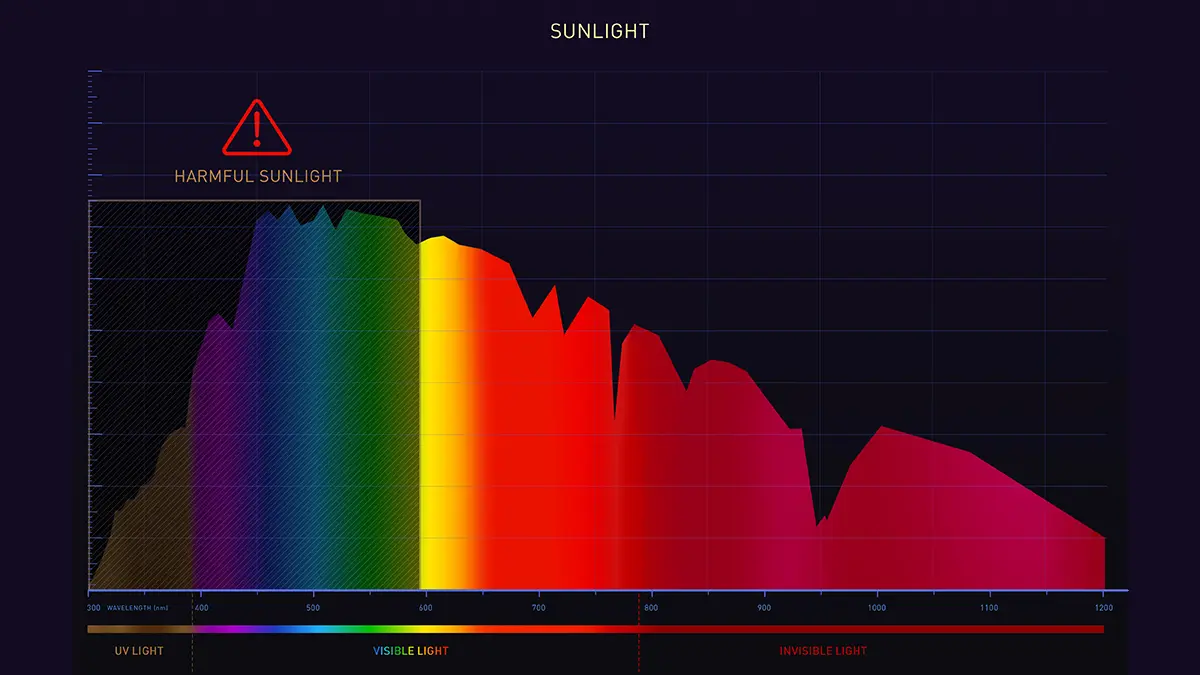
All of you who've been with us for a while know that we do enjoy a nice, dramatic intro and outro, sandwiching the proven facts of the article body. But there is no unnecessary drama in claiming that the sun is an absolute king ruling the possibility of life and life rhythms on the entire planet. One proper solar flare and every bit of electronics we built our life around and rely on for everything would be fried, back to the Middle Ages in seconds. A few more without the Earth's magnetic fields and it's sayonara to the species. But yes, the sun is a fundamental installation enabling life, ruling circadian rhythms, growing crops, helping you hold on to sanity, detoxing the body, synthesizing vitamins, and supercharging the immune system while disinfecting pathogens.
Although sunlight seems like one uniform thing, a simple regular white light, it contains a range of wavelengths, from ultraviolet (UV) to visible light and infrared (IR). When it comes to skin recovery and rejuvenation, red and NIR light have been proven to have the most healing effects on our skin.
We, humans, are very practical, and it is sort of counterintuitive to think about skincare as light-based. For us, light has a pragmatic function of allowing us to see (which is how we get 90% of information about our surroundings). But light is basically energy, which, transmitted to living skin cells, has some real biological effects, such as:
- Stimulating cellular energy (ATP) production
- Supporting tissue repair and regeneration
- Boosting collagen synthesis and skin health
The effects of light therapy are cumulative and result in improved cellular function and faster skin repair, be it fine lines and wrinkles, acne scars, or sagging due to loss of elasticity. So why not just go into the sun for your daily dose of light therapy? You absolutely should, and it will be very beneficial for various aspects of your mental and physical health. But after about 15 minutes in direct sunlight with no protection (can be more or less, depending on your skin tone and how much melanin your skin naturally produces), the benefits plummet as UV radiation and blue light start to cause photoaging, DNA strand damage, and hyperpigmentation. If you've ever seen the face of a senior person who did prolonged work in the sun for decades, you know what sort of damage we're talking about. Sun damage accounts for about 90% of premature skin aging.
Full-spectrum red light vs. traditional red light?
The 500 collection from FOREO's sister brand, FAQ™ Swiss, is such big news because it's the first at-home device to combine broad-spectrum and narrow-wavelength light technologies. The new type of device featuring full-spectrum red light therapy (applying to both FAQ™ 501 and FAQ™ 502) is vastly superior to the narrow red light therapy that hit our at-home spas in the early 2000s and has since blossomed.
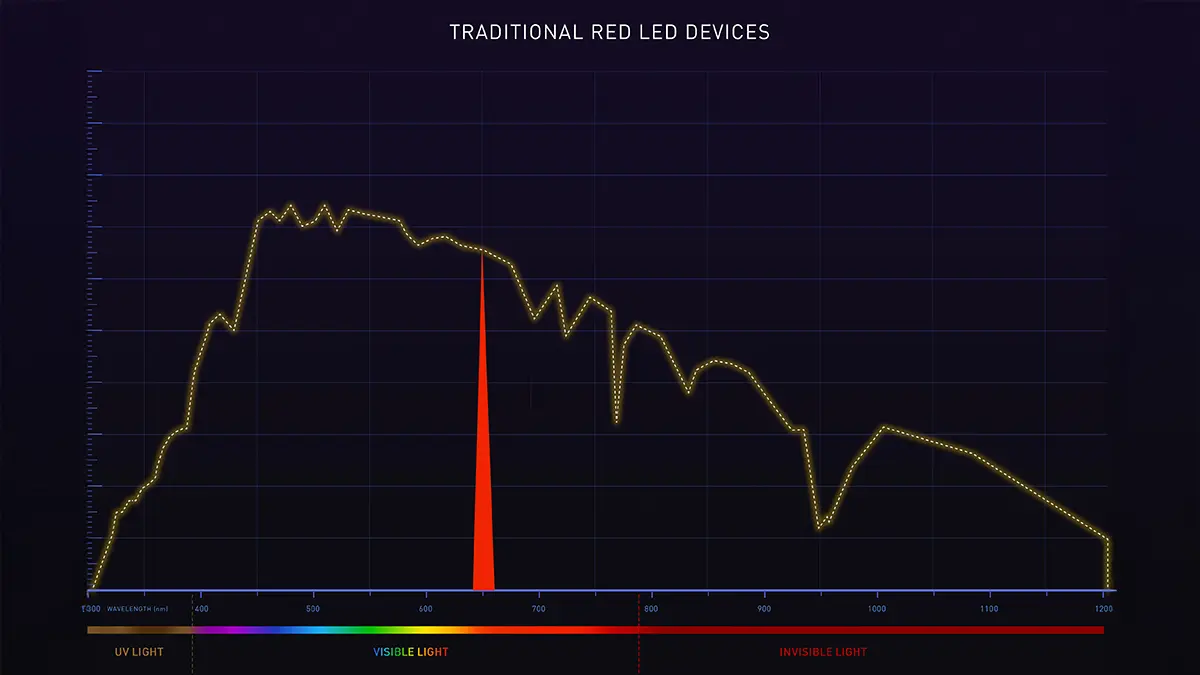
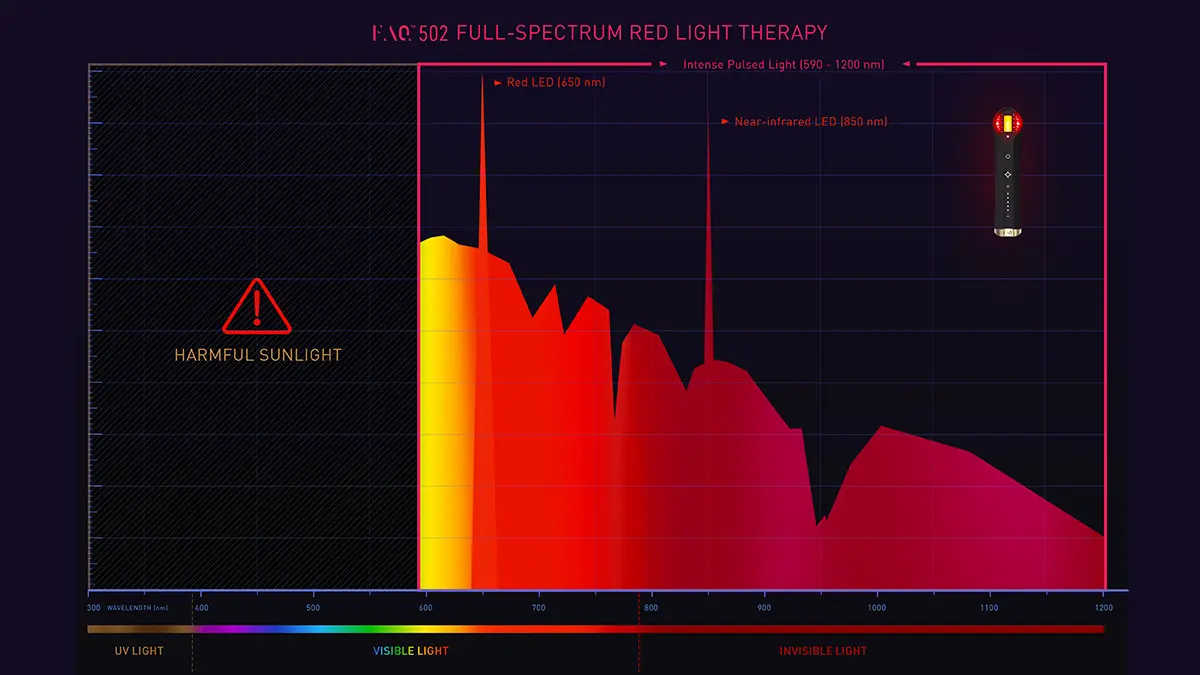
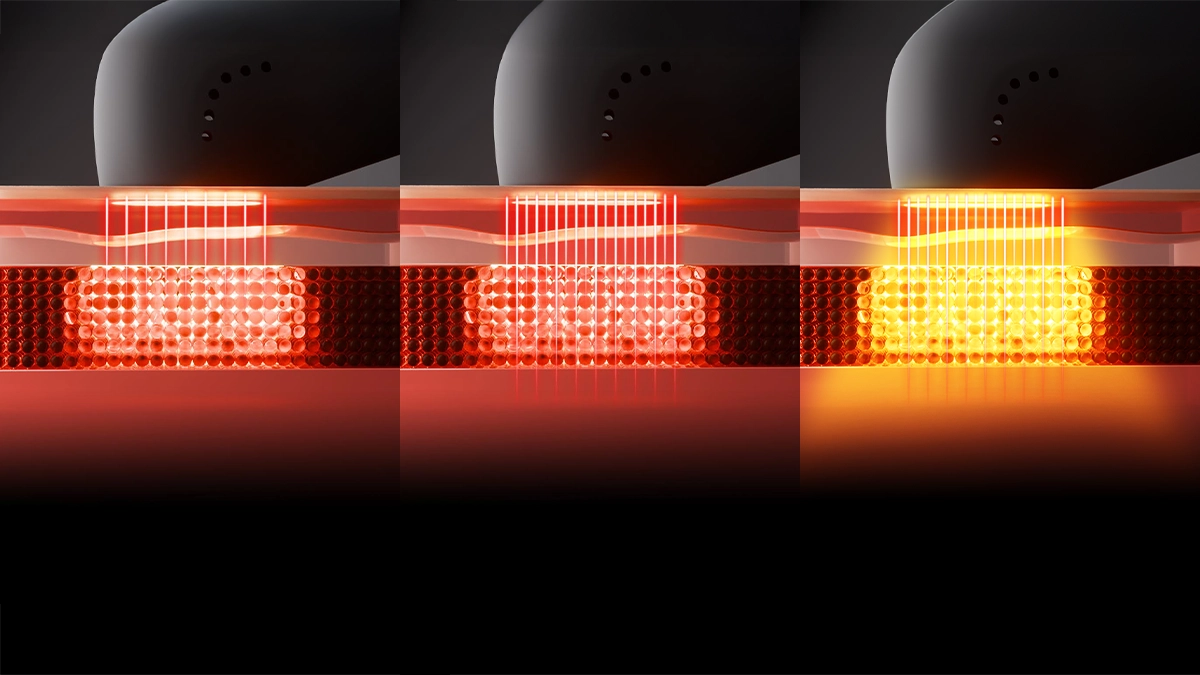
Full-spectrum means that both FAQ™ 501 and FAQ™ 502 mimic the full spectrum of the sun’s natural healing wavelengths from the red domain (502 also has NIR), rather than just zoning onto a single isolated light wavelength, as is the case in traditional red light therapy. In traditional therapy, you would have, let's say, a single red wavelength of 650nm. It will be effective, but also not living up to its full potential, which is to be gained from the interactions and entourage effects with all other beneficial wavelengths. The FAQ™ 500 devices are superior to regular red light therapy because they use a broad and narrow wavelength range of 590-1200 nm, working simultaneously at various tissue depths.
It is the difference between a single singer and the power of a quire with mics, between a hyperdose of one vitamin (which will do some good if you need that vitamin exactly) and a proper multivitamin that considers balance, and not hyperdosing its goal. Plus, we're all different and will not react the same to identical skincare or treatments. So if you have a spectrum rather than an isolated wavelength, there is a far better chance you'll hit (and take) exactly what you need. This interplay of broad and narrow wavelengths is what allows the FAQ™ 500 collection at-home light therapy to have the best results across multiple skin layers, rather than one singular, precise depth.
Key tech & benefits of the FAQ™ 500 Collection
We've sort of licked the corners of all the essential aspects of why the 500 collection stole the show in the at-home anti-aging device landscape. Now that you've got the main concept down, we can go into a bit more detail about specific LED wavelengths or types of LED therapy, so it is easier to understand the difference between FAQ™ 501 vs FAQ™ 502 and what you specifically need.
BROAD-SPECTRUM PULSED LIGHT
Uses a very broad wavelength range from 590-1200 nm that penetrates the epidermis and mid-to-deep dermal layers, targeting multiple tiers of chromophores. If you've never heard of a chromophore before, think of it as a specialized structure in the skin that absorbs light at a specific wavelength and deals with that light as energy. Melanin is a chromophore.
The pulsed part suggests that the light is not constant. The treatment effect is enhanced with up to 10 powerful pulses of light per second. The principle is this: rather than steady light, pulsed light allows cells to take a breather and "rest" in between flashes. Cells don't work on our macro schedules, and these micro rests will boost mitochondrial function, ATP production, and collagen synthesis more effectively than holding the light steady.
Broad-spectrum pulsed light is available with both FAQ™ 501 and FAQ™ 502 and is the core that will jumpstart the chain reaction of rejuvenation, regardless of your skin's stage of aging when you start. Obviously, it will be able to help someone who started early more than someone whose skin is already showing seriously advanced signs of aging, but the only way not to see results with broad-spectrum pulsed light is if you lose the device in that everything drawer that time has forgotten (we all have one).
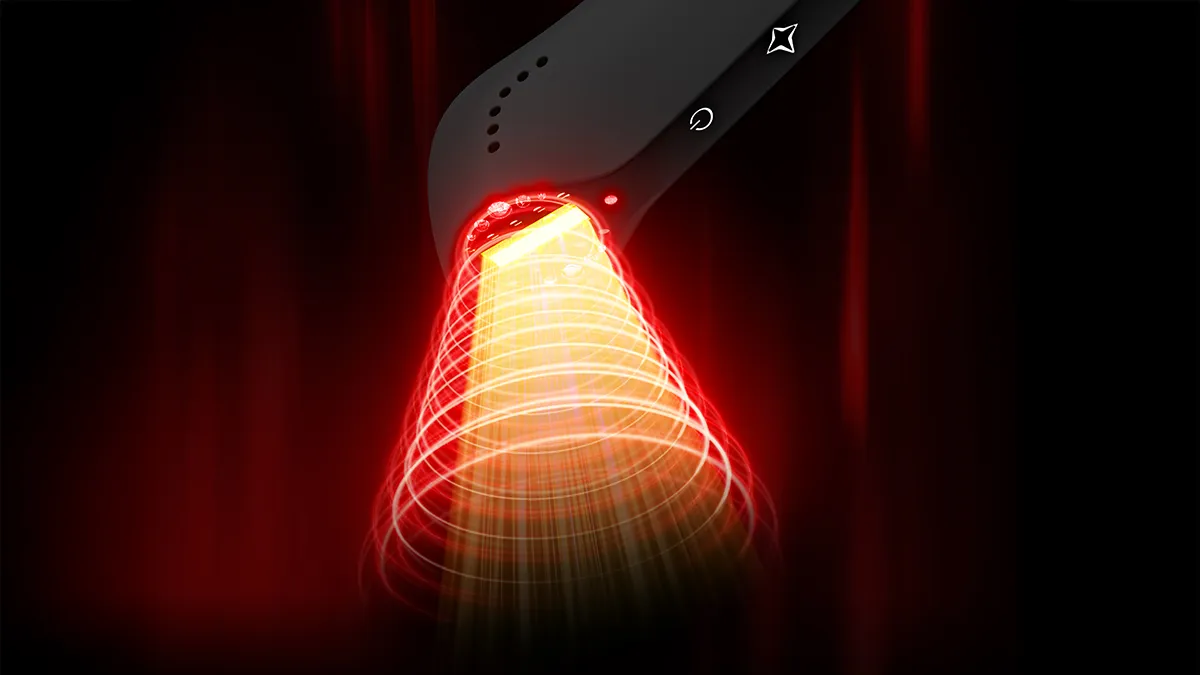
The main benefits include overall skin rejuvenation by addressing those stubborn pigmentation issues (age spots, melasma) that make you look blotchy and unkept, redness (rosacea), and minor scarring. It will, unfortunately, not do much for that deep scar you've had since you were six, so manage your expectations.
It works because the intense pulses of light are absorbed by chromophores, which convert them into brief bursts of heat energy. The heat helps break down accumulated pigment and stimulates collagen synthesis through controlled damage. This time, the damage is thermal rather than mechanical, from, let's say, microneedling. No skin penetration, just perfectly calibrated light pulses.
NARROW LED WAVELENGTHS
Now, narrow LED wavelengths are by no means less worthy of praise. They are great for targeting very specific problems. The light hits an exact single depth of tissue (red light (650 nm) targets superficial layers; near-infrared (850 nm) penetrates deeper into the dermis), and is an excellent targeted treatment to support cellular healing.
The refreshed cells will operate with new vigour, reverting to the function of their younger selves, or will be replaced by new, fresh, and plump cells, as the senescent (old) cells naturally slough off, channeling our inner gecko. Narrow LED wavelengths hit fine lines and wrinkles, improve skin tone, and reduce acne breakouts and acne-related inflammation. Keep in mind that NIR light that hits deeper skin layers is one of the greatest differences between FAQ™ 501 and FAQ™ 502.
This steady (rather than pulsed) red light delivers a constant, low-level energy that is readily absorbed by the precious mitochondria in skin cells. Increased cellular energy production (ATP), makes a huge difference. Imagine you had the energy from when you were 17 now. How much more could you accomplish with that energy, this skill, and this experience combined? This is the life your skin cells are living once exposed to LED light therapy.
FAQ™ 500 Collection benefits and LED clinical proof
There are many benefits, and it is kind of hard to tease out which wavelength is responsible for which benefit exactly, as the device works sort of like a symphony. It is impossible to choose a single instrument that doesn't play off the entire rhythm and sound.
IMPROVES PIGMENTATION
And as sunspots, and age spots, and discolorations, oh my! Not as scary, but way more persistent than lions, tigers, and bears, hyperpigmentation is a reality of aging skin. The collection will do some serious heavy lifting in pigmentation irregularities of various causes, and consistent use will result in a visibly more even and youthful complexion.
MINIMIZES WRINKLES
We presume you've started this journey infinitely annoyed by the lines on your face getting deeper and more pronounced, or noticing that your facial expressions are getting etched onto your face.
Light therapy stimulates collagen and elastin production, helping to reduce fine lines and wrinkles and improve firmness by rejuvenating the skin structure. The FAQ™ 500 collection minimizes fine lines and wrinkles by reviving collagen and elastin production, and as your skin firms up, lines will become less visible. Tie a really firm high ponytail and look at your face now. It will be like that, just without going bald from abusing the pony.
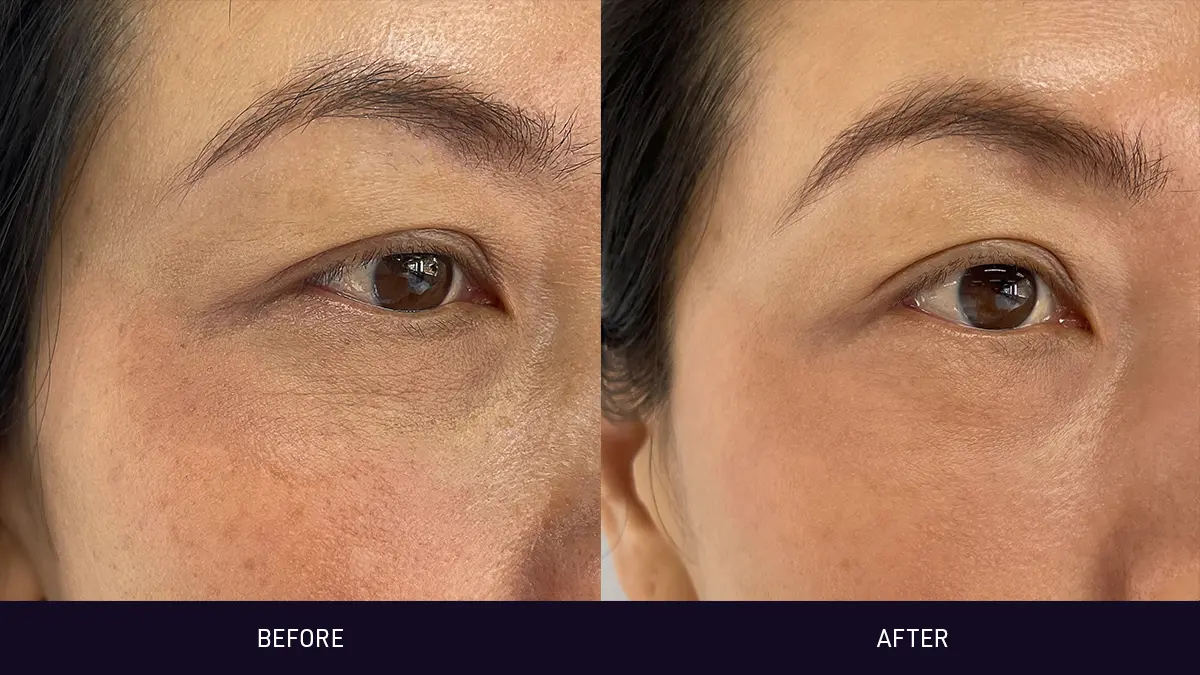
TREATS ACNE & SCARRING
If there is one thing everyone looks forward to as they grow older, it is looking forward to their skin clearing up and stabilizing. The horror is palpable once you realize that acne and breakouts are not only reserved for your pre-midlife self, but acne can hit anytime, anywhere. The thing that changes is that scars fade more slowly as you get older, because cell turnover has slowed. Light therapy non-invasively targets the already irritated and sensitive breakout spots, killing acne bacteria. This will reduce breakout frequency, while accelerated tissue healing will help soften and fade the appearance of scars. No one can promise you'll never have a breakout again (whoever does is either lying or delusional), but you'll never get it as bad.
REDUCES REDNESS
Redness and rosacea make people very self-conscious. A nuisance, yes, but they mostly mean you either have some loop inflammation going on, have seriously reactive skin, or a weakened barrier that takes offense to usually harmless handling or skincare. FAQ™ 500 collection is ideal to treat sensitive or inflamed skin due to the non-invasive nature of light therapy, which effectively calms redness and rosacea by targeting the underlying causes of skin inflammation, leading to a more balanced complexion.
Both devices in the 500 line share some features, a surname that connects the 500 bloodline to the entire FAQ™ anti-aging universe. 501 and 502 both have 5 intensities to choose from, so you can tailor your treatment to personal needs and a treatment area of 3.1 cm². As the pulsed and narrow light may produce some heat, and the brand spoiled us with user-friendliness before, there is also a skin-cooling mechanism.
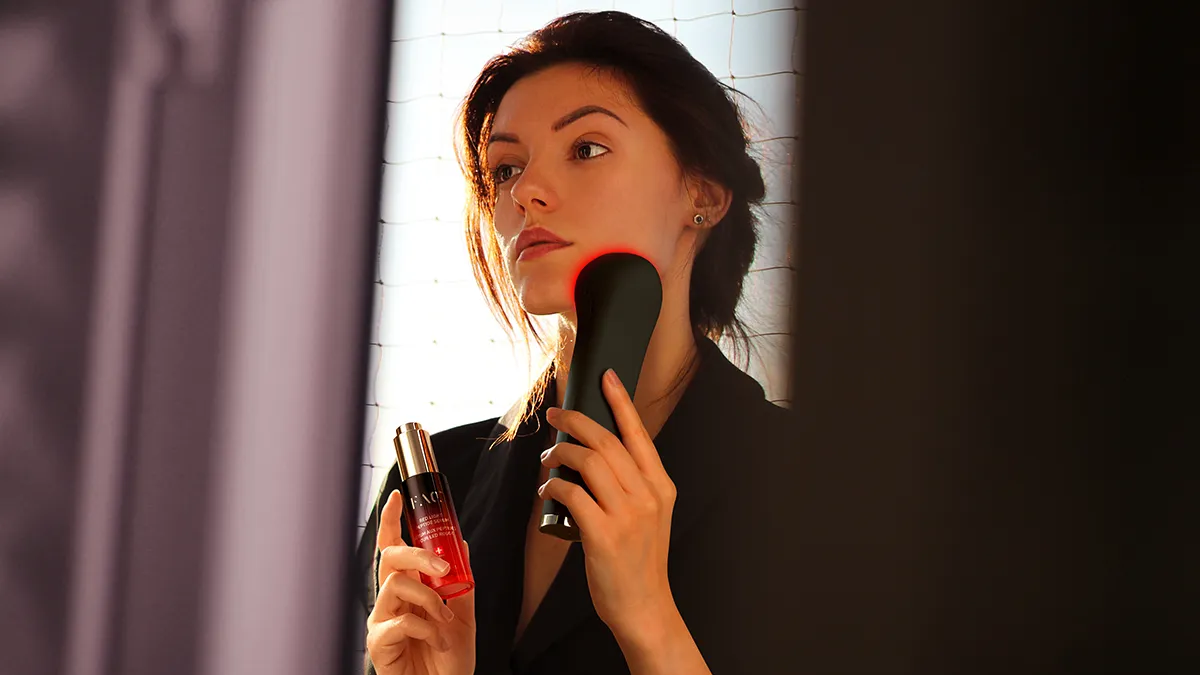
Both devices are app-connected and feature video-guided treatments to help you learn the most beneficial movements. They are also wireless and rechargeable and require just a 2-minute treatment 2-3 times a week for best results, because we also have lives and schedules outside of wanting to look fabulous.
You may also choose a topical - FAQ™ Red Light Peptide Serum - that works for both devices, amplifying light therapy results, and complementing LED light treatments in general. This all-in-one antioxidant-rich serum boasts collagen-boosting Peptides, brightening Sea Daffodil, hydrating HA, soothing Green Tea & repairing Cica. Either way, you'll be gliding the devices across skin, and you do need some slip. If you choose some of your own skincare products, make sure the ingredients are stable and won't deteriorate when exposed to strong light.
Clinically proven benefits
Abundant and amply available clinical proof supports the benefits of light therapy, left and right, focusing mainly on red and NIR light clinicals. These wavelengths have shown the most promise in addressing common skin issues people notice as they age, such as sagging, loss of elasticity, texture changes, pigmentation deterioration, and lines and wrinkles. What does the most clinical proof agree upon for specific FAQ™ 500 collection wavelengths that 501 and 502 have in common?
Red LED 650 nm
Red light is clinically proven to boost collagen and elastin, the two most important and irreplaceable structural proteins in the body that keep our skin in one piece and looking fresh and taut. No collagen, and the body would basically fall apart, as collagen gives strength. No elastin, and your skin and connective tissues would be brittle, completely inelastic, and break at the first mechanical force. This light will be best for improving superficial lines and fading wrinkles.
Pulsed-light 590 - 1200 nm
We've already mentioned that pulsed light has "breaks" that may not always be perceptible to us if the pulsing is fast enough. These breaks allow for higher peak flash power without risking heat damage to tissue, enabling targets like melanin destruction in hyperpigmentation or killing acne bacteria. The pulsing will cause a photochemical cascade, boosting ATP and greatly enhancing healing and repair.
Pulsed light is clinically proven to improve the look of pigmentation & accelerate the healing of acne & minor scarring. But a good takeaway is that pulsing, rather than a continuous light wave, allows deeper penetration than holding the light steady. This feature becomes ever more critical as the signs of aging become more pronounced.
FAQ™ 501 vs FAQ™ 502: Which one is right for you?
To answer this question properly, we'll first need to go through the main technological and performance differences between FAQ™ 501 and FAQ™ 502, so we can better understand the rationale behind the recommendations.
The most prominent technological difference in the FAQ™ 501 vs FAQ™ 502 duel is the absence of NIR light therapy in the 501.
When you think NIR, think deeper penetration and more effects on the structures responsible for skin texture and tone. We're so used to hearing these words that they become just beige noise, void of meaning. We need to adjust our viewpoint and get resensitized to the importance of tone and texture. You know when you look at someone and can't quite determine their age because you understand they are not in their 50s or 60s, but you see a neglected face that could be 35 or 45. This is due to tone and texture. When we're frustrated by a general loss of freshness, and there is nothing in particular we can put our finger on to regain our youthful vigour, this is also it. Uneven texture and a loss of bouncy skin tone can make us look older than necessary, even if there aren't any real wrinkles to haunt our dreams of eternal youth just yet.
Near-Infrared LED 850 nm is clinically proven to work on the cell's mitochondria, boosting ATP output. This means you'll push recovery into hyperdrive, helping improve the appearance of that worrisome, worsening uneven skin texture & tone.
Why does NIR work so well to smooth skin texture? Think of yourself when you don't have enough energy. You barely get through the day. Working on yourself is out of the question, as you revert to survival mode, and only basic actions (skipping some of those, too, shhh). This happens to a cell. A tired old cell with malfunctioning energy production is not thriving; it's just surviving. Since it's still sort of alive, it doesn't give its place to a new, fresh cell. Without repair and regeneration, the deterioration accumulates and soon becomes visible to the naked eye, as dull, sagging, rough, blotchy skin. This is why ATP matters. Once the cell can use its food (fat and carbs; proteins build structures; they are not burnt for energy before the starvation point) and its oxygen supply to generate more ATP in the mitochondria, it optimizes its function. Finally, it has some leftover energy to rebuild and restore.
NIR greatly encourages collagen renewal and cellular turnover, helping to improve roughness for that touchable quality, like you spend your days in a hamam (a Turkish bath, you need to touch the skin of a woman working there, maaan). It will also reduce pore size, which balloons somewhere over 35, and enhance overall skin quality for a smoother, more radiant finish. NIR is the one that will have people squinting at you in a month, trying to figure out what you've had done.
When to choose the FAQ™ 501?
You don't necessarily need the 502 if your interest is prevention (in your late 20s) or if you have early signs of aging. Barely perceptible lines that weren't there last year, some strange hyperpigmented areas that are not going away, breakout spots and scars hanging around for longer than before, skin getting drier than usual (could signal a deterioration in the skin barrier), pores getting bigger, and a loss of that glow that you've considered a given in your 20s. Is that jawline getting less sharp? Do crows' feet seem to hang around a bit after you've laughed your heart out?
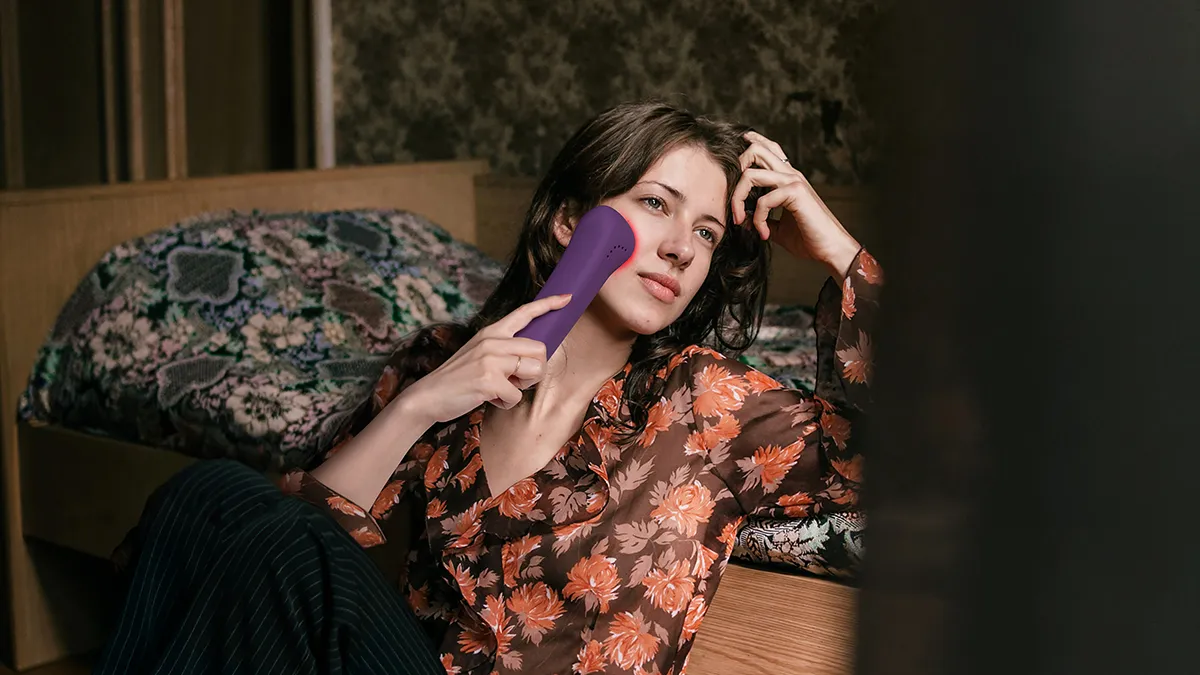
All of these early signs are not yet deep and may not need an intervention with NIR. The red light will probably suffice for your needs for a couple of more years, maybe a decade if you've started prevention on time. The pulsed broad-spectrum will give some midlayer support, so there is no need for the intensity of the continuous NIR use.
So, ideally, you'd choose the FAQ™ 501 if you just need some help maintaining your youthful freshness or restoring your recently lost glow, with a non-invasive yet very effective therapy. You may, of course, do the 502, and keep it for decades to come.
When to choose the FAQ™ 502?
We tend to think of advanced aging as the skin that is beyond help, bar a glistening scalpel, blood, bruising, and paying through the nose. But it is not so. More advanced signs of aging, such as significant sagging and formation of jowls, more profound wrinkles, substantial volume loss (sunken cheeks), more age spots, palpably thinner and drier skin, and veins, are reflections of decreased collagen, fat, and elasticity. You're not doomed. This is where we'd recommend choosing the 502 with its deeper-penetrating NIR.
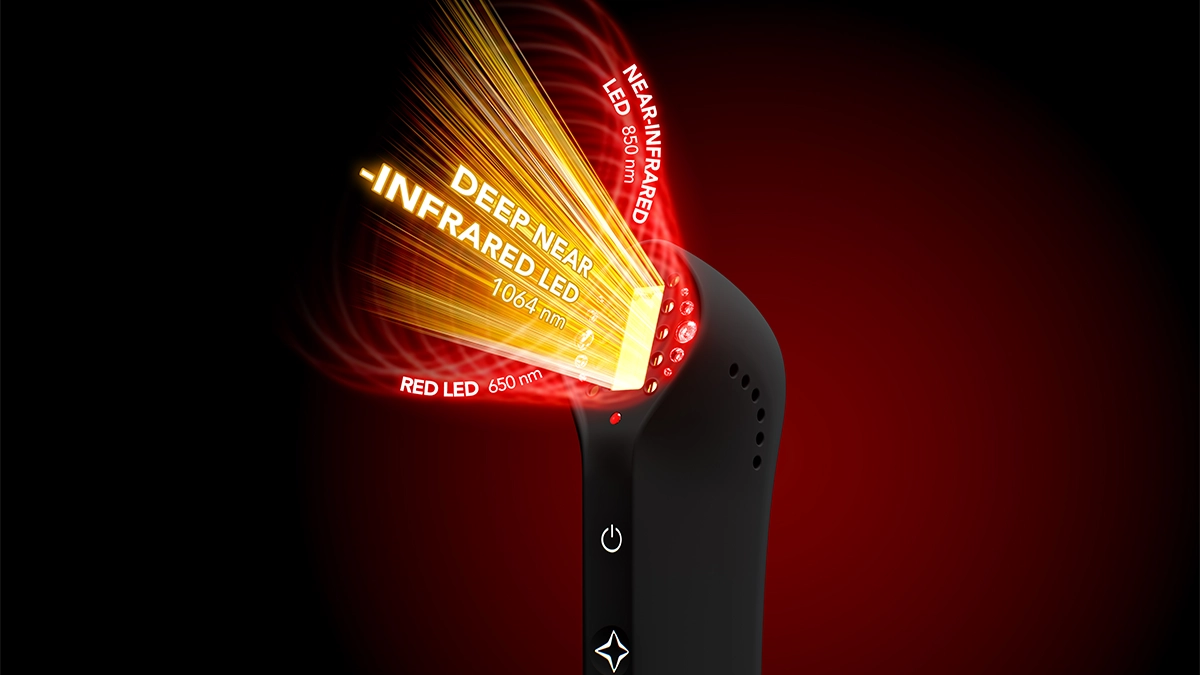
The FAQ™ 502's NIR is not the same as going into an infrared sauna. It will not relieve inflammation of internal organs or reach joints or brain tissue. It is adapted to hit all skin layers. It is an anti-aging device perfectly calibrated to its purpose. For full-body effects, you should consider a red light panel.
If you're more into investing than buying. You may want the FAQ™ 502 right from the start, regardless of your age, which you can then learn to use like the 501 while you need it and graduate to the 502 capabilities once you feel it's time.
Also, keep in mind that the 502 has a bit more power and a faster flash for the pulsed light (10 flashes/second, as opposed to 7/sec in the 501), which means you'll be 30% better at hitting those mid layers than with the 501. But, as we said, you may not need to hit harder, but just gently coax the cells into self-repair.
Conclusion
Take all of this into consideration, weigh both sides, compare them with what you need and how long an investment you’re looking at with light therapy here, and choose what fits you, your needs, age, skin state, financial resources, and lifestyle the best.
We, personally, prefer a face that has lived a bit and has a few stories. But we are also determined to take care of ourselves and are proud to have challenged gravity for a duel, fully aware that one can not beat the reality of aging forever. But we can try our best and scream not yet with a defiant smirk on our fresh face.
We hope you found some useful information here today. Consider the aging process a necessary payment for the privilege of a long life, raise a glass to geckoes, stay cool, curious, and enjoy living in your skin, dear friends.






Leave a comment