16 min read
Red Light Therapy vs Infrared: Wavelengths, Benefits & Applications

Red light therapy vs. infrared? Is there any difference at all? The more you Google red light therapy, the more confused you get. I hear you, sisters (and misters). In a world overflowing with information, there is a lot of unhelpful fluff trying to make you buy things and services you don't need, installing smoke and mirrors around facts to obscure the view of the truth. So we're here today to get down to the nitty-gritty and answer all sorts of questions you may have to the best of our abilities. We're gonna stick to the science in our snazzy white coats, making it digestible without a need for an advanced degree in optics. If any of you hold one, congratulations, your pants are smart, and feel free to correct us in any way, shape, or form, as this will be non-physicist (optics is a branch of physics) written.
We'll go through questions like:
- What are infrared and near-infrared (NIR) lights? Are they safe?
- Are they the same, but like to go under posh pseudonyms for fun?
- Are infrared and near-infrared better or worse than red light therapy?
- When should you use red, infra-red, or NIR light therapy?
- Can you combine these?
And other satellite questions that might have been orbiting your queries on red light, NIR, and infrared, the benefits of each of these light therapy branches, which can be seen with the naked eye, and how to choose what is right for you specifically. We've got a lot to cover, so light speed ahead.
What is light therapy?
Remember the mentioned pseudonyms that keep confusing your red light therapy vs infrared investigations? Well, light therapy has many names, but they all refer to the therapeutic use of light for skin rejuvenation, tissue healing, pain and inflammation management, fertility improvements, and many other exciting new areas of research, such as brain health. Some synonyms you might find in the texts include:
- photobiomodulation (PBM)
- red light therapy (RLT)
- cold laser therapy
- red light therapy vs infrared
- LED light therapy
- phototherapy
- biostimulation
There are more names, specific to certain fields or treatments for particular conditions, but they all work on the same principle: light at specific wavelengths has a beneficial effect on biological systems. The difference to know is that LEDs are incoherent light sources, whereas lasers are coherent sources, better at targeting a precise area with intense treatment, and can be used at low energy to avoid potentially dangerous heat.
What is a wavelength?
To go further and follow the explanations, you'll need to know what a wavelength is. Light, all light is made out of photons, the tiniest light particles, yet still light behaves as a wave also, in addition to its particle nature. This is why we say that light exhibits wave-particle duality and that it travels without a need for a medium (such as air or liquid). It is perfectly capable of passing through Earth's atmosphere, as it is traveling through the vacuum of space at 300,000 km/s.
When we speak about wavelengths of your red or infrared light in this piece, we're speaking of light as a wave where wavelength (seen as color in visible light) is the distance between two corresponding points in one wave cycle, let's say two consecutive crest peaks. The sunshine warming your cat's belly and making you squint has all the wavelengths in it, including the harmful ultraviolet (UV) radiation (<400 nm), visible light (380-780 nm), and infrared range (>780 nm), and we do get some X-rays and radio waves too.
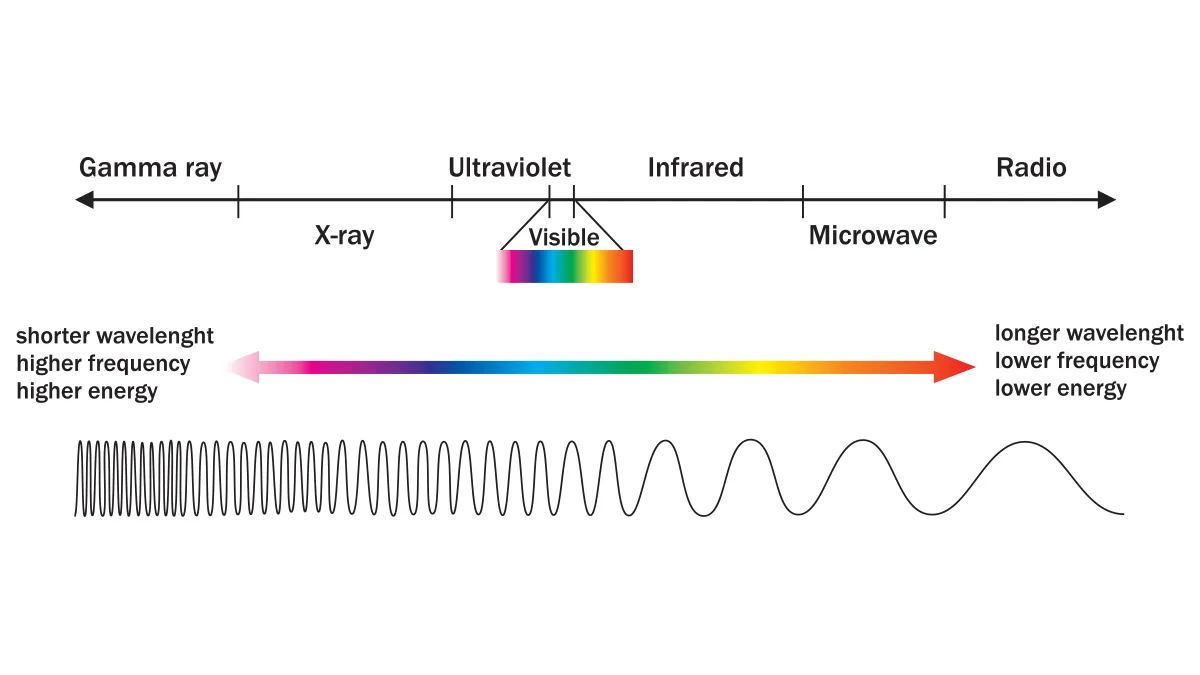
When considering the benefits and wavelengths of red light therapy vs infrared, we're talking about the therapeutic window, which includes red light from the visible spectrum and infrared wavelengths spanning from NIR to far infrared. So, in light of this (see what we did there?!), why wouldn't you just step out into the sunshine for your light therapy, and why should you ever pay for it? Well, you should step into the sunshine, especially early morning or near sunset, to regulate your circadian rhythm, get some precious vitamin D synthesized, and ro regulate your mood and sanity. Yet, when you're spending extended periods of time in the sun, you'll get a lot of UV with the therapeutic window, and some of the others you don't want mutating your genetic material.
When the sun is concerned, we're not much different than a plant on your windowsill. It hits us with everything, and we take what we need and defend from the rest with evolutionary and man-made protections. So do get about 15 minutes of direct sunshine on skin daily for general health and wellbeing, but if you want to fix some existing damage to cells and tissues, you'll need to go radical and concentrate the therapeutic window wavelengths on the affected areas, and we’re lucky to live at a time in history when this is finally possible. We use and relish the non-invasive, quite alienesque light therapy, still kind of freaking out about how light, which we're taking for granted (unless tripping on a toy on the floor), can have a serious impact on our system. It will make it easier if, for the rest of this long exposure, you think of light as radiation, electromagnetic radiation. This will help you absorb the fact that we're dealing with energy.
Is red light therapy the same as infrared
Now, here's the money shot - yes and no.
Yes, because they both fit in the therapeutic window of wavelengths, they both fall under light therapy (and will sometimes be named interchangeably in bad science or flimsy product claims), but you now know that these are different wavelengths, although both can help biological systems heal and rejuvenate.
No, because the different wavelengths affect the light properties and how deeply it penetrates tissues, and therefore their benefits on the living systems. No, because red light therapy will mostly be used to treat signs of aging and conditions on the skin surface, and the further we go into NIR and infrared, the deeper the penetration of the photon gets, reaching all the way to the bone, muscle, and brain tissue.
Remember how we said to think of light as energy. This is what photones do. Different wavelengths of light deliver energy to cells of different tissue depths. For cells struggling due to aging, injury, nutrient or oxygen deficiency, exposure to toxins or sugar, or inflammation, increased photon delivery can help invigorate mitochondria. Mitochondria are the cell power plants that create ATP (adenosine triphosphate) by burning oxygen and nutrients such as sugars and fats. They won’t burn protein unless you’re starving, because protein is more valuable as a building material.
The influx of extra energy delivered via red and infrared light therapy photons allows the cells to thrive rather than barely survive in a sluggish, unhealthy environment. This new power-up gives them some leftover energy to dedicate to repair and restoration, rather than just doing the lowest-of-the-low, basic functions to get by. In this regard, the answer to "Is red light therapy the same as infrared?" is yes. It just depends on the level of tissue at which this restart occurs, which is determined by the wavelength. Unlike red and NIR light, in the mid- and far-infrared, some energy will be perceived as warmth. Btw, if you can feel warmth coming through your clothes when the temperature outside is lower than human body temperature, that’s the sun’s IR radiation reaching you.
Differences between red light and infrared light: Quick Overview
In normal circumstances, one would put this Quickie at the beginning of the article and therefore be praised and rewarded by the SEO gods. But in this instance, one thought that you (the people) should know all the little details and explanations to help you understand the story of red light therapy (also, one used "one" due to overwatching the Crown lately). So, unfavored by the disembodied powers of search engines, here are the quicklook at the differences between red light and infrared light, that you can return to as a cheat sheet.
- 620–630 nm: Red light, shallow (skin surface) penetration, reduces inflammation, improves circulation, supports wound healing, and improves skin barrier
- 660–670 nm: Red light, medium (epidermis/dermis) penetration, boosts collagen, reduces wrinkles, treats acne, improves skin tone
- 810–830 nm: Near-Infrared (NIR), deep (muscle & joints), speeds muscle recovery, reduces joint pain, supports brain function
- 850 nm+: Infrared, deepest (up to bone) penetration, enhances endurance, supports bone repair, reduces inflammation.
What is red light therapy?
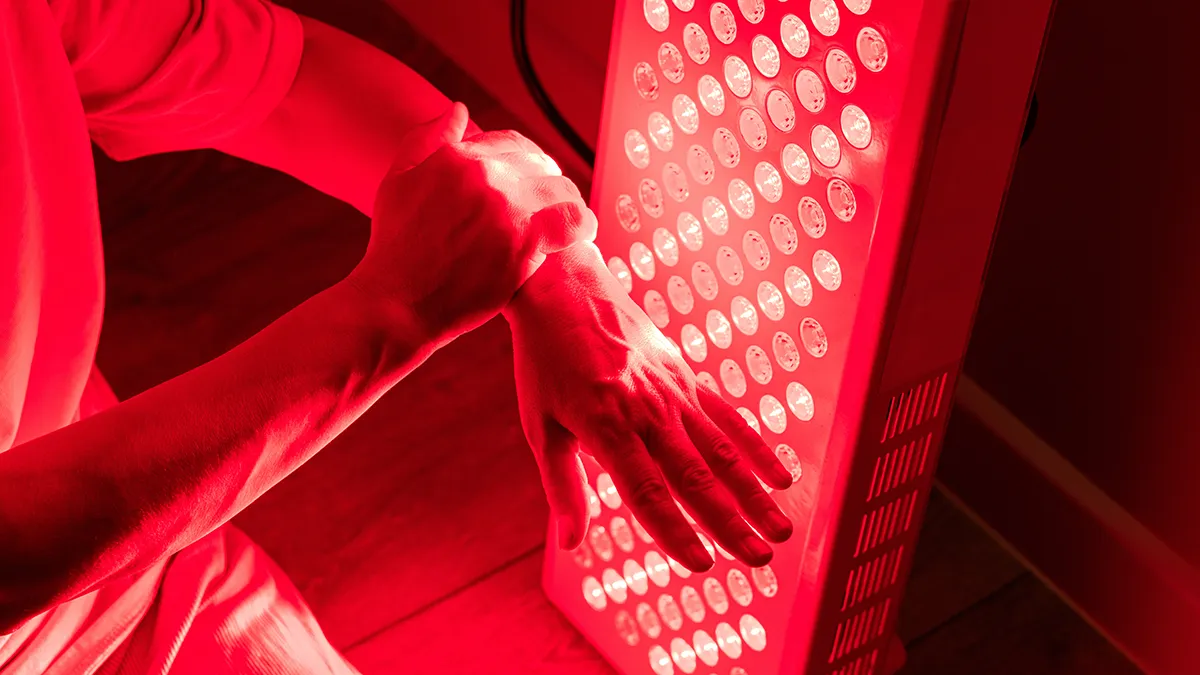
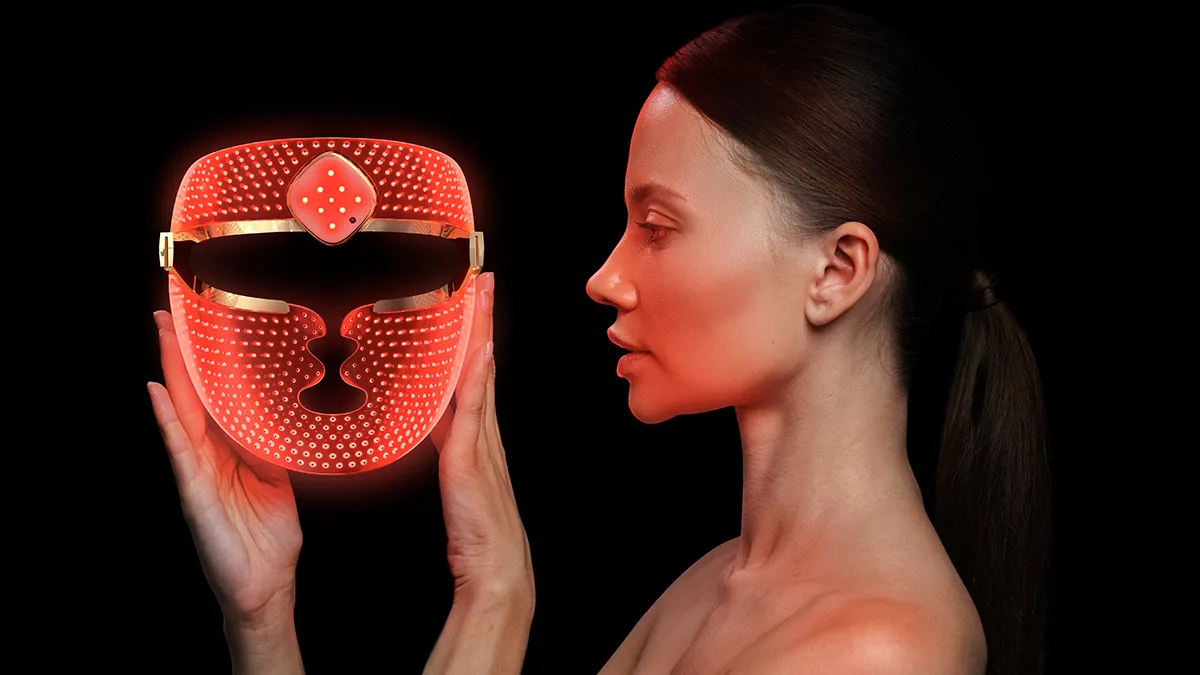
Red and infrared light have different effects on the body. Red light is a part of the visible light spectrum, which is why you can see your at-home red light masks emitting the radiant deep red, making you look helishly good. A good red light rejuvenation device or treatment will use 620–750 nanometers (nm) light, and you should keep in mind that these rays don’t really travel deep and that your device should be in contact with the skin because they lose energy exponentially as they get further away from the skin. Red light panels are stronger because they compensate for not having direct skin contact, and that's why you should follow instructions about the proper distance from a panel.
With red light therapy, you'll get the most bang for your buck if your concerns are on the surface or just below it. This is the light most often used for the repair and rejuvenation of the uppermost skin layer because it is very effective in stimulating collagen production, fighting of free radicals (that are a normal byproduct of being alive and beathing, but cause premature signs of aging, the bastards), soothing chronic or acute inflammation, and supporting skin cell regeneration and turnover, which may help with scar tissue remodeling.

You'll also be glad to know that the 620–630 nm range improves microcirculation and lymphatic drainage, flooding your skin with oxygen and nutrients while helping flush out toxins that cause puffiness. It's not only about consuming more, but also about getting rid of waste more effectively.
Think: glowing, firmer, clearer skin, even tone, fortified skin barrier, fresher face with fewer lines and wrinkles, calmed down eczema or psoriasis.
Red light therapy potential benefits:
- Increased collagen synthesis (see red light before and after photos) is the most important structural protein
- Fewer fine lines and wrinkles, less sagging, and sun damage recovery
- Hair strengthening and hair regrowth benefits
- Reducing inflammation to lower the frequency of acne and breakouts
- Healing of non-melanoma skin cancers (always, always consult your dermatologist or GP before starting red light therapy on suspicious skin lesions)
- Accelerated wound healing is very useful in post-operative scars if started early
- Reduction of swelling and inflammation due to injury
- Recovery from athletic fatigue
What is infrared therapy?
This will include NIR, mid-infrared, and far-infrared (which you'll usually find in IR saunas rather than in at-home red light therapy devices). Infrared therapy uses longer wavelengths, invisible to the naked eye, and also carries some heat energy. Infrared therapy starts just beyond red light (typically 780nm) and may still have a somewhat perceptible red glow at lower NIR wavelengths. Sometimes, the manufacturer of your NIR light therapy device will introduce some red glow just so you know that you've turned your device on with the invisible wavelengths. You're not really seeing IR light in those instances because your eyes just weren't built to see it (unlike vipers, bats, mosquitoes, salmon, goldfish, and some beetles, making these able to move and hunt in total darkness by following heat signatures).
The higher we go, all the way into mid- and far-infrared, the deeper the tissue penetration, and the wavelengths are now definitely invisible. With NIR, especially in mid to deep IR, you'll reach muscles, joints, connective tissue, and even bones and the brain, where it enhances circulation, speeds up tissue repair, and eases pain and inflammation.
Think: recovery, relaxation, and long-term healing, and some very exciting research in brain rejuvenation regarding Alzheimer's and Parkinson's diseases.
NIR therapy potential benefits:
- Improved muscle healing after exertion that broke fibers (we actually make the muscles grow by causing microtears in the muscle fibres and then repairing them)
- Faster wound healing and recovery from plastic surgery
- Benefits for deteriorating brain, neurological damage, stroke, or brain injury, due to better circulation and more energy production
- Helps alleviate anxiety and depression symptoms
- Reduced infection risk
- Improved bone repair and growth
- Faster healing after a sports injury
While both therapies rely on photobiomodulation principles (i.e., using light to biologically activate cells), their effects are opposite yet highly complementary, as you can see.
The difference between NIR, mid-infrared, and far-infrared?
Near-Infrared (NIR) light is the beginning of the IR spectrum, the infrared wavelengths closest to visible light, ranging from about 700 nm to 1300nm (0.7 to 1.3 micrometers). Compared with red light therapy, which penetrates only a few millimeters, NIR light can penetrate several centimeters into tissues. This makes it excellent for non-invasive therapeutic applications in muscle recovery, circulation improvement, and deeper skin rejuvenation for advanced signs of aging. This is why NIR is often used in the best light therapy devices because it stimulates cellular energy production (mitochondrial function) and supports tissue repair much deeper than red light alone, without risking heat damage (which may be an issue with overexposure to wavelengths further down the infrared spectrum).
Also called mid-IR, MIR, or Mid-Wave Infared (MWIR), it is a subset of infrared radiation, a bridge between NIR and far infrared, and can range from 1300-3000 nm (1.3 to 3 micrometers). Mid-IR light is absorbed more deeply by water molecules in the skin and tissues, which leads to greater heat generation and is commonly used in applications involving heat therapy (such as saunas or some dermatological treatments). Because it partially converts to heat, it has a less direct impact on cellular photobiomodulation than NIR, and is more focused on pain relief and improving circulation than rejuvenation, but you may still find it in some anti-aging devices; it’s more medicinal than aesthetic.
Far-infrared (FIR) goes up to 1,000,000 nm (1mm), with the lower ends used for deep detox and intense sweating. And since you'll be sweating from IR radiation, not the room's heat, you can keep the cabin temperature much more comfortable, which some people prefer.
MIR and FIR potential benefits:
- Deep pain relief
- Treating cancer, in the form of photoimmunotherapy
- Reducing chemotherapy side effects particulary those connected to the oral mucosa or nerve damage
- Also, accelerating the healing of the brain after injury
Red light therapy vs. infrared: So, which is better?
Well, better is not really the issue here. Both red and infrared are good, useful, and effective treatments. The question would be better put as, is red light therapy or infrared better for you and your needs? The focus is on individual approaches and your concerns and desired results. Someone young who's interested in prevention or is seeing first lines and wrinkles may be quite alright with just using red light therapy. If you're seeing more obvious signs of aging, such as deeper lines and wrinkles, visible loss of elasticity, sagging, dullness, and blotchiness, you may benefit more from greater infrared light penetration depth and achieve a better outcome by using NIR or combining red and NIR light in your skincare routine. Often, it is not red light therapy vs NIR, but rather a complementary interplay between the two. By combining therapies, you'll get one treatment that will simultaneously hit the surface skin layers and deeper tissues.
If you’re in your 20s and early 30s just looking for brighter skin (you may be spending a lot of time indoors, under unatural lighting breathing stuffy air), reduced redness (due to sun overexposure, barrier damage-caused reactivity, inflamatory conditions like rosacea or psoriasis), fewer wrinkles (our moods and expressions will get etched into our face over time), and that enviable glow (lost to a poluted urban climate that makes you skin lethargic and dull), red light therapy is your best bet. It works at the surface level to stimulate collagen, calm inflammation, and restore that fresh glow you remember from when you didn't have to try at all.
Infrared has systemic effects on muscle, recovery, inflammation, joint pain, brain health, and a myriad of other life- and health-quality-enhancing features. By improving circulation and revving up cellular repair beneath the skin surface, infrared effects are more mechanical in nature (at least before they go so deep into the infrared that the energy is mostly converted to heat and used for deep detox or thermal therapies). In skincare, infrared (mostly NIR) is used to enhance skin tone for a more lifted, chiselled look, which you get from a very aggressive ponytail. It will also reduce puffiness by increasing circulation and allowing lymph to take away the metabolic garbage, and support natural collagen production in deeper layers that will serve as scaffolding, toning, and lifting the skin above. So basically, it is not red light therapy vs infrared, but red light and infrared.
Red and NIR light therapy + skincare
Light therapy enhances skincare absorption, and skincare actives make it even more effective. If you’re going to be using both red and NIR light in your skincare routine, you can, of course, get separate devices, but it makes sense to get an advanced device that offers both capabilities if you’ve stepped into your 30s. Here’s how to combine skincare and phototherapy and make the most of both worlds:
- Start with a Clean Face: This is a universal step for every single routine or treatment you do. No way around it if you don’t want to just waste time and resources. So, make sure to remove all makeup, sunscreen, product residue, and impurities to ensure the light penetrates effectively. Consider deep dual cleansing before light sessions.
- Begin with Red Light Therapy: Use red light first, as it works on the skin’s surface to stimulate collagen, reduce inflammation, and improve texture. A session of about 10–15 minutes is ideal, but follow the instructions on your device of choice. Can you use red light therapy every day? Some are stronger than others and may not need 10-15 minutes, some you can use daily, some a couple times a week. Red light overexposure will not give you results faster, but it may irritate the skin and cause redness and dryness.
- Apply Your Skincare Products: After red light therapy, skin is more willing to absorb for a while, so this is a perfect time to layer on your expensive serums and moisturizers (we all lie to the people we live with about their price, it’s ok, this way you’ll actually use them).
- Follow with Near-Infrared Light Therapy: Use NIR next. Once again, ideally for 10–15 minutes, but follow the device instructions as you did with the red light. By now, you’ve learnt that NIR light penetrates deeper, supporting circulation, reducing inflammation beneath the skin, and promoting tissue repair. This is perfect for enhancing skin firmness and overall vitality. If you’re using any type of light-therapy serum, you’re pretty much ok and don’t need to do anything else.

Extra tips:- Eye Protection: Most at-home devices (except red light panels due to their high intensity) do not require eye protection and do not have built-in eye shields or filters. But if the device demands it, always protect your eyes during light therapy sessions by wearing goggles.
- Stay Consistent: Nothing works if you don’t use it - not muscle, not brain, nor red light therapy. Aim for regular sessions, about 3–5 times a week, for the best long-term results, and the effects will get better the longer you use the therapy.
Conclusion
If you’ve made it this far through the red light therapy vs infrared maze, here’s the calm, intelligent answer. This isn’t a wavelength competition. It’s a matter of being informed, of depth, intention, and proper application.
When people ask, “Is red light therapy the same as infrared?” the honest answer is no - but they are neighbours on the electromagnetic spectrum that have a lot of things in common. Both sit within the therapeutic window of photobiomodulation, enhancing the function of living cells. Both deliver energy and stimulate mitochondrial function, resulting in optimized cellular respiration and ATP (cellular energy) production. The real difference between red light and infrared lies in wavelength, which translates into how deeply that energy travels and at what tissue depth it gets absorbed, reflecting on the benefits of the therapy.
Red light (ideally 620–670 nm) works primarily at the skin level. It’s ideal for collagen support, surface rejuvenation, reduced inflammation, barrier repair, and a visible glow. Infrared - particularly NIR red light therapy in the 810–850 nm range - penetrates deeper into muscle, connective tissue, joints, and even brain tissue. It supports recovery, circulation, pain modulation, and deeper structural rejuvenation.
So whenever you see red light therapy vs infrared framed as a binary choice, it’s an oversimplification. The smarter framing is red and infrared light therapy working together, fusing the benefits of surface and depth interventions. Glow plus structure. Skin plus deeper support systems.
If your concerns are mostly aesthetic and superficial - early fine lines, uneven tone, mild inflammation - red light may suffice. If you’re dealing with deeper laxity, muscle recovery, joint discomfort, or you want to amplify results beneath the dermis, infrared - especially NIR - is the better choice. And for many people, the sweet spot isn’t red light therapy vs NIR. It’s a strategic combination.
Understanding the difference between red light and infrared means you can stop chasing marketing claims, you can demand proof before your wallet goes bulimic, and start choosing intentionally, voting for quality with your money. Depth matters. Dose matters. Wavelength matters. Your goals matter. That’s the real takeaway: not which is “better,” but which is appropriate and whether using both gives you a more complete biological response.
Light isn’t magic. It’s physics meeting biology at the micro scale, with macro-scale cumulative effects. And once you understand that, the confusion disappears.
We hope you found some valuable information here today and that you're leaving us a bit more knowledgeable than when you found us. Stay curious, cool, and gorgeous, and enjoy living in your skin.





Leave a comment